Apollo: The First Moon Landings
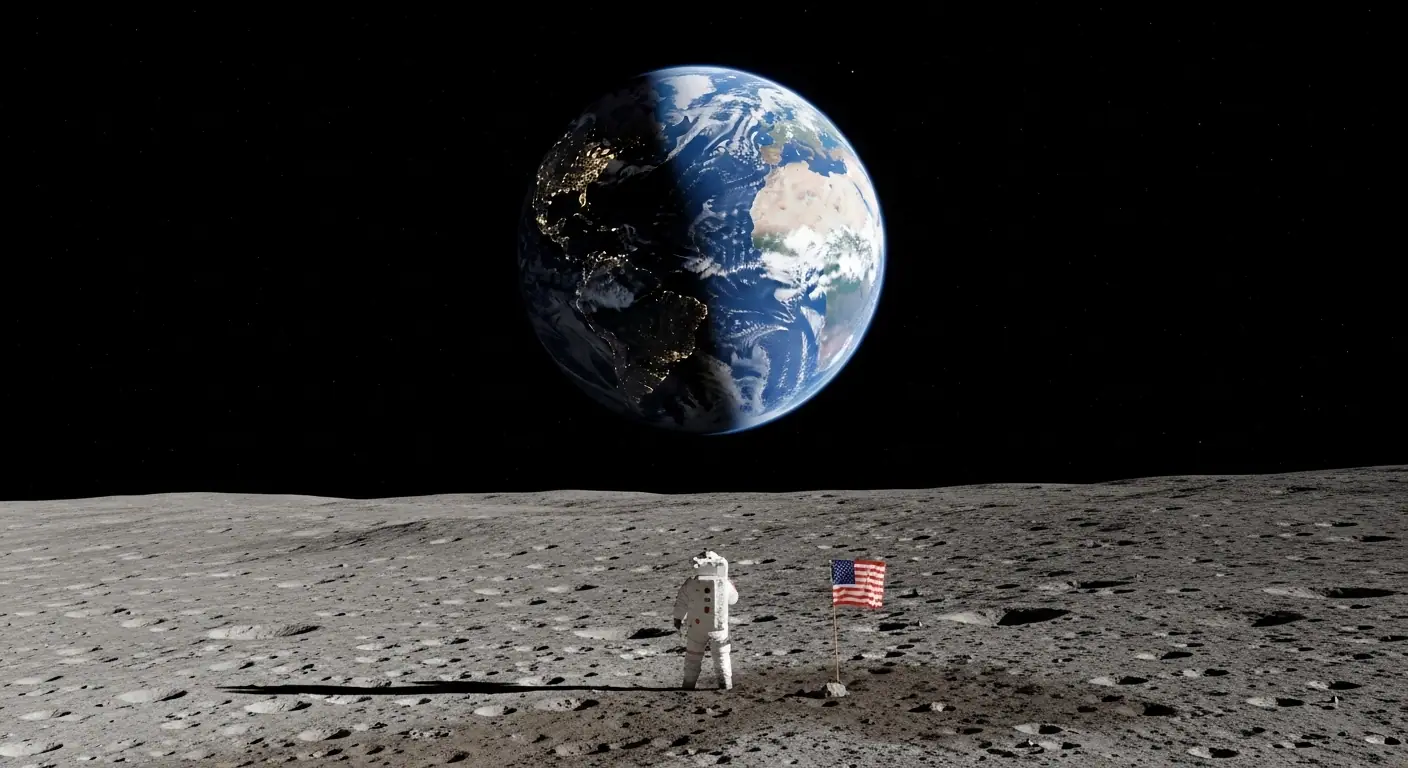
NASA's Apollo program put twelve astronauts on the surface of the Moon across six landings between 1969 and 1972 -- a Cold War-era engineering effort that remains humanity's only crewed exploration beyond low Earth orbit, and the direct ancestor of today's Artemis program.
Mission Timeline
From the fatal Apollo 1 fire through ten uncrewed and crewed test flights to six successful Moon landings, every Apollo mission built on the one before it.
Apollo 1
A flash fire swept through the Block I command module during a "plugs-out" launch pad test at Cape Kennedy, killing all three astronauts in seconds. The pure-oxygen cabin atmosphere and a cabin fitted with flammable materials turned a wiring spark into an inferno the inward-opening hatch could not be opened fast enough to escape. The mission was renamed Apollo 1 at the request of the crew's widows. It remains the only in-mission fatality of the entire Apollo program.
Key Milestones
- Program's only in-mission fatalities
- Command module redesigned after investigation (Block II)
- Outward-opening quick-release hatch introduced
- Planned Feb 21, 1967 launch scrubbed; NASA paused crewed flights for 20 months
Apollo 4
The first flight of the Saturn V rocket and the first "all-up" test of an entire Apollo/Saturn stack flying together for the first time. The uncrewed command module re-entered the atmosphere at a simulated lunar-return speed to validate the heat shield before any crew flew it.
Key Milestones
- First Saturn V launch
- "All-up" testing strategy validated
- Heat shield tested at simulated lunar-return re-entry speed
Apollo 5
First flight test of the Lunar Module, uncrewed, in Earth orbit. Ground controllers fired the descent and ascent engines -- including a simulated abort staging -- to prove the lander could perform the maneuvers a crew would later depend on to reach and leave the lunar surface.
Key Milestones
- First Lunar Module flight test
- Descent and ascent engines fired in orbit
- Simulated an emergency staging abort
Apollo 6
The second and final uncrewed Saturn V test flight. The vehicle suffered severe pogo oscillation and two second-stage engine failures, but engineers traced and fixed the causes quickly enough that NASA judged the rocket ready to carry a crew on the very next flight.
Key Milestones
- Second uncrewed Saturn V test
- Overcame pogo oscillation and engine anomalies
- Cleared Saturn V for crewed flight
Apollo 7
The first crewed Apollo flight, an 11-day Earth-orbit shakedown of the redesigned, safety-hardened Block II command and service module that followed the Apollo 1 fire. Included the first live television broadcast from an American crewed spacecraft.
Key Milestones
- First crewed Apollo mission
- First American live TV broadcast from space
- Validated the redesigned Block II command module
Apollo 8
The first crewed spacecraft to leave low Earth orbit, reach the Moon, and orbit it. Borman, Lovell and Anders entered lunar orbit on Christmas Eve 1968 and read from the Book of Genesis during a live broadcast watched by hundreds of millions. Anders captured the famous "Earthrise" photograph during the mission.
Key Milestones
- First humans to leave Earth orbit
- First crewed lunar orbit, Christmas Eve 1968
- "Earthrise" photograph taken by Bill Anders
- Genesis reading broadcast to what was then the largest TV audience in history
Apollo 9
First crewed flight of the Lunar Module, tested in Earth orbit. McDivitt and Schweickart undocked the LM from the CSM, flew it independently, then redocked -- rehearsing the exact maneuver a crew would need at the Moon. Schweickart also tested the self-contained Apollo spacesuit and backpack on a spacewalk.
Key Milestones
- First crewed Lunar Module flight
- First docking between CSM and LM with crew aboard
- First test of the self-contained PLSS backpack spacesuit
Apollo 10
A full dress rehearsal for the Moon landing, short of actually landing. Stafford and Cernan flew the Lunar Module to within roughly 15 kilometers (8.4 nautical miles) of the lunar surface before firing the ascent engine to rejoin Young in lunar orbit -- deliberately leaving the first landing for the next flight.
Key Milestones
- Full dress rehearsal for the Moon landing
- Lunar Module descended to within ~15 km of the surface
- Fastest speed ever reached by a crewed vehicle on the return to Earth
Apollo 11
The first crewed Moon landing. Armstrong and Aldrin landed the Eagle on July 20, 1969, while Collins orbited alone in Columbia. Armstrong became the first person to step onto another world, radioing "That's one small step for man, one giant leap for mankind." The crew spent about 21.5 hours on the surface, including roughly two and a half hours outside the lander.
Key Milestones
- First humans on the Moon, July 20, 1969
- "That's one small step for man..."
- ~21.5 kg (48 lb) of lunar samples returned
- Watched live by an estimated 600 million people worldwide
Apollo 12
The second Moon landing, and the first true precision landing -- Conrad and Bean touched down within easy walking distance of the robotic Surveyor 3 probe, which had landed there in 1967, and retrieved parts of it for analysis back on Earth. The Saturn V was struck by lightning twice during ascent but flew on safely.
Key Milestones
- Pinpoint landing beside the Surveyor 3 probe
- Retrieved Surveyor 3 hardware for study
- Survived two lightning strikes during launch
- Color TV camera disabled after accidental exposure to the Sun
Apollo 13
An oxygen tank in the service module ruptured roughly 56 hours into the flight, crippling Odyssey's power and life support. The crew moved into the Lunar Module Aquarius and used it as a lifeboat, looping around the Moon on a free-return trajectory to bring the crew home safely -- the mission that gave rise to "Houston, we've had a problem" and NASA's label of a "successful failure."
Key Milestones
- Oxygen tank explosion roughly 56 hours into flight
- Crew used Lunar Module Aquarius as a lifeboat
- "Houston, we've had a problem" -- landing aborted, crew returned safely
- Widely cited as NASA's defining crisis-management success
Apollo 14
The third Moon landing, targeting the Fra Mauro highlands originally assigned to Apollo 13. Alan Shepard -- America's first person in space back in 1961 -- became the fifth person to walk on the Moon and, at 47, the oldest Apollo moonwalker, famously hitting two golf balls across the lunar surface before departing.
Key Milestones
- Landed at Fra Mauro, Apollo 13's original target
- Alan Shepard became the fifth person to walk on the Moon
- Shepard hit two golf balls on the lunar surface
- First use of the wheeled Modularized Equipment Transporter cart
Apollo 15
The first of the extended "J-class" missions, with a longer surface stay and expanded science payload. Scott and Irwin were the first crew to drive the battery-powered Lunar Roving Vehicle, exploring the base of the Apennine mountains and Hadley Rille. Worden performed the first deep-space EVA on the return trip to retrieve film canisters from the service module.
Key Milestones
- First mission to use the Lunar Roving Vehicle
- Longest lunar surface stay of the program to that point (~3 days)
- First deep-space EVA, performed by Al Worden
- Explored the Apennine mountains and Hadley Rille
Apollo 16
The first landing in the lunar highlands rather than the smoother mare (basalt plains) targeted by earlier missions, chosen in hopes of finding volcanic material. Young and Duke instead found the highlands were built largely from breccia formed by ancient impacts, an important correction to pre-mission geological theories. Young later commanded the first Space Shuttle flight in 1981.
Key Milestones
- First landing in the lunar highlands
- Used the Lunar Roving Vehicle for extended traverses
- Revised scientific understanding of highland geology
- John Young later commanded the first Space Shuttle mission
Apollo 17
The sixth and last crewed Moon landing to date. Harrison Schmitt, a trained geologist, was the only professional scientist to walk on the Moon, and the mission returned the largest haul of lunar samples of the program. Cernan's final words on the surface -- a promise that Apollo would return "with peace and hope for all mankind" -- remain the last spoken by a human standing on the Moon.
Key Milestones
- Last crewed Moon landing (to date)
- Harrison Schmitt -- the only professional geologist on the Moon
- Longest surface stay and most samples returned of the program
- Eugene Cernan is the last person to have walked on the Moon
Spacecraft & Hardware
The Apollo architecture combined the most powerful rocket of its era with a two-part spacecraft purpose-built to land two astronauts on the Moon and bring three home.
Saturn V
363 feet (111 m) tall, three stages, roughly 7.5 million lbf (34,020 kN) of thrust at liftoff. Flew 13 times with 13 successes and remained the most powerful rocket ever flown until Starship.
Command/Service Module
Built by North American Aviation. Carried three astronauts to lunar orbit and back; only the conical Command Module returned to Earth. Redesigned as "Block II" with a fast-opening hatch after the Apollo 1 fire.
Lunar Module
Built by Grumman. Two-stage spider-legged lander -- a descent stage that stayed on the Moon and an ascent stage that carried two astronauts back to lunar orbit. Flown on 10 missions, landed on 6.
Apollo A7L Spacesuit
Multi-layer thermal micrometeoroid garment worn by every moonwalker. The backpack-mounted Portable Life Support System supplied about 7 hours of oxygen, cooling water, and radio communications.
Lunar Roving Vehicle
Battery-powered "Moon buggy" used on Apollo 15, 16 and 17. Folded to fit in the Lunar Module descent stage and extended crew traverse range to several kilometers from the landing site.
The Twelve Moonwalkers
Twelve American astronauts walked on the Moon across six Apollo landings. As of 2026, four are still living.
Neil Armstrong
Apollo 11
Buzz Aldrin
Apollo 11
Pete Conrad
Apollo 12
Alan Bean
Apollo 12
Alan Shepard
Apollo 14
Edgar Mitchell
Apollo 14
David Scott
Apollo 15
James Irwin
Apollo 15
John Young
Apollo 16
Charles Duke
Apollo 16
Eugene Cernan
Apollo 17
Harrison Schmitt
Apollo 17
Apollo's Legacy
Apollo grew directly out of the Cold War space race: after the Soviet Union launched Sputnik in 1957 and put Yuri Gagarin into orbit in 1961, President Kennedy committed the United States to landing a man on the Moon "before this decade is out." The program is commonly cited at roughly $25.4 billion in 1973 dollars -- about $257 billion when adjusted to 2020 dollars, though exact modern-day equivalents vary by source and index.
Beyond the political victory, Apollo returned about 382 kg (842 lb) of lunar rock and soil across six landings, samples still being studied today. Astronauts' accounts of seeing the whole Earth from the Moon fed into what writer Frank White later named the "Overview Effect." The program is also credited with accelerating integrated-circuit manufacturing (the Apollo Guidance Computer was one of the first major uses of ICs), and with the development of hardware like cordless power tools built for lunar drilling.
No human has traveled beyond low Earth orbit since Apollo 17 in December 1972. NASA's Artemis program is Apollo's direct successor -- built to return astronauts to the lunar surface, this time with a sustained presence, using a new rocket and spacecraft but chasing the same goal Apollo first proved possible.
about 382 kg of Moon
samples to show for it
Related Content
Dive deeper into the Saturn V rocket, NASA's current lunar program, and the broader history of spaceflight.
Artemis: Apollo's Successor
NASA's current program to return astronauts to the Moon -- with a new rocket, a new spacecraft, and a permanent lunar presence in mind.
Saturn V Rocket Profile
Full specs on the rocket that sent every Apollo crew toward the Moon -- still among the most powerful ever flown.
NASA Company Profile
The agency behind Apollo, Artemis, and decades of American spaceflight -- profile, programs, and current status.
Space Industry Timeline
See where Apollo fits into 80+ years of spaceflight history, from V-2 rockets to the commercial space era.
All Space Missions
Browse our full mission tracker with launches, orbital operations, and deep space exploration.
Space Companies Directory
Explore 1,700+ companies building the future of spaceflight, including Apollo's contractors and their successors.
See what came next
Apollo proved a Moon landing was possible. NASA's Artemis program is the effort to go back -- and stay.