Best Telescopes for Beginners 2026: Complete Buying Guide
Choosing your first telescope is exciting and surprisingly easy to get wrong. This guide cuts through the marketing hype to tell you exactly what to buy at every budget — and what to realistically expect to see through the eyepiece.
Walk into any optics store or scroll through Amazon and you will find hundreds of telescopes, many of them disappointingly bad, a few of them genuinely excellent. The problem is that marketing copy rarely tells you which is which. Department-store telescopes boast "450x magnification!" when that level of magnification would produce nothing but a blurry blob. Meanwhile, some of the best beginner scopes look unassuming in photographs. This guide separates fact from fiction, explains the concepts that actually matter, and gives you specific, honest recommendations for every budget from $100 to over $1,000.
The One Thing That Actually Matters: Aperture
If you remember nothing else from this guide, remember this: aperture is everything. Aperture is the diameter of the telescope's main lens or mirror, the opening that collects light from the sky. A larger aperture collects more light, which means brighter images, more detail, and the ability to see fainter objects. This one specification determines your telescope's capability more than any other.
Magnification, by contrast, is almost irrelevant when comparing telescopes. You can change magnification simply by swapping eyepieces. A telescope advertised as "250x" is not better than one advertised as "100x" — both numbers are meaningless without knowing the aperture. High magnification applied to an inadequate aperture just produces a large, fuzzy, dim image. The atmosphere itself limits useful magnification to about 50x per inch of aperture (roughly 2x per millimeter). A 60mm telescope maxes out at useful magnification of about 120x, regardless of what the box claims.
For a beginner telescope, aim for at least 70mm of aperture for a refractor, or at least 114mm to 130mm for a reflector. These sizes will show you the Moon's craters in spectacular detail, Jupiter's cloud bands and four Galilean moons, Saturn's rings with their gap clearly visible, Mars as an orange disk with polar ice caps, and deep-sky objects like the Orion Nebula and Andromeda Galaxy.
Types of Telescopes: Refractors, Reflectors, and Compound
Telescopes fall into three main optical categories. Understanding the differences helps you choose the right instrument for your goals.
Refractors use a glass lens at the front of a sealed tube to gather and focus light. They are the classic telescope design — what most people picture when they think of a telescope. Refractors produce sharp, high-contrast images and are virtually maintenance-free because the sealed tube protects the optics from dust and requires no collimation (optical alignment). Their main limitation is cost: large-aperture refractors become very expensive because large precision glass lenses are difficult to manufacture. For beginners, refractors in the 70mm to 102mm range are excellent, practical instruments. Budget for a refractor: $80 to $300 for a solid beginner scope.
Reflectors (specifically Newtonian reflectors) use a curved mirror at the bottom of the tube to gather light, which is then reflected to a secondary mirror and out through an eyepiece at the side of the tube. This design delivers far more aperture per dollar than refractors, making reflectors the best-value telescopes for beginners who want to see the most sky for their money. The 130mm and 150mm Newtonians that dominate the beginner market are exceptional value. The trade-off is that mirrors can require occasional collimation — a quick adjustment to keep the mirrors aligned — and open-tube designs can let in dust. Neither issue is a serious problem with a little care.
Compound telescopes (also called catadioptric telescopes) use a combination of mirrors and lenses. The two most common designs are the Schmidt-Cassegrain Telescope (SCT) and the Maksutov-Cassegrain (Mak-Cass). Both fold a long optical path into a compact tube by bouncing light between mirrors, resulting in an instrument that is shorter and more portable than its aperture would suggest. Compound scopes are typically more expensive than reflectors of similar aperture but offer versatility: they work well for both visual observing and astrophotography. The Celestron NexStar series uses compound optics and is a popular step-up scope for serious beginners.
Mount Types: What Holds Your Telescope
The mount is often overlooked but is just as important as the optics. A telescope on a shaky, poorly designed mount is frustrating to use. There are three main types.
Alt-azimuth (alt-az) mounts move the telescope up-down (altitude) and left-right (azimuth). They are intuitive to use — you push the tube where you want to point it — and are ideal for beginners. Most beginner telescopes ship with alt-az mounts. They are perfectly adequate for visual observing of planets, the Moon, star clusters, and bright nebulae. Their limitation is that they cannot easily track objects across the sky as Earth rotates, which matters for long-exposure astrophotography but is irrelevant for casual visual observing.
Equatorial (EQ) mounts tilt one axis to align with Earth's rotation axis, so that a single slow rotation in one direction tracks objects across the sky. Manual equatorial mounts are common on mid-range beginner scopes and are useful for extended observations once you understand how to align them. They look intimidating but are straightforward once you understand the principle. They are bulkier and heavier than alt-az mounts.
GoTo computerized mounts are the most user-friendly option for beginners who struggle to find objects in the sky. After a brief alignment procedure using two or three bright stars, a GoTo mount can automatically slew to any of thousands of catalogued objects at the press of a button. The Celestron NexStar SE series uses GoTo mounts and makes finding faint objects trivially easy. The trade-off is cost and battery life. GoTo mounts are excellent for beginners who live in light-polluted areas where the sky looks mostly blank.
Dobsonian mounts deserve special mention. A Dobsonian is a specific type of alt-az mount designed for large-aperture reflectors, using a simple but effective rocker box design. Dobsonians are inexpensive, stable, and allow you to build a large-aperture telescope at relatively low cost. The Sky-Watcher 8" Dobsonian, for instance, has more light-gathering power than most GoTo scopes costing twice as much.
Top Picks by Budget
Under $150: Celestron StarSense Explorer DX 130AZ
At around $130 to $150, the Celestron StarSense Explorer DX 130AZ is the most impressive beginner telescope at this price point in 2026. It is a 130mm Newtonian reflector on an alt-az mount — solid aperture for the price — but its standout feature is the StarSense Explorer app. A cradle on the telescope holds your smartphone and uses the phone's camera and the StarSense software to analyze the star field visible overhead and tell you exactly where the telescope is pointing and how to navigate to any object in the database. This is the closest thing to a GoTo mount without the GoTo price tag, and it makes finding objects dramatically easier for beginners who struggle with star charts.
What you will see: crisp Moon views, Jupiter's four moons and cloud bands, Saturn's rings, the Orion Nebula, Andromeda Galaxy as a faint smudge, and dozens of star clusters. This is a genuine, capable telescope that will serve you well for years.
$150–$400: Sky-Watcher Heritage 130P Tabletop Dobsonian
The Sky-Watcher Heritage 130P (around $180 to $220) is arguably the best value telescope in the entire beginner market. It is a 130mm Newtonian reflector on a tabletop Dobsonian mount — meaning it sits on a flat surface rather than a full tripod. This design makes it compact, lightweight, and quick to set up. The optics are excellent for the price. The collapsible tube makes transport easy. And at 130mm aperture, it genuinely outperforms many scopes costing twice as much.
The catch: you need a stable table or surface to put it on, which some people find inconvenient in the field. But for backyard use from a patio table or picnic bench, it is essentially unbeatable at this price. This is the scope we would recommend to most first-time buyers.
$400–$800: Celestron NexStar 4SE
The Celestron NexStar 4SE (around $500 to $600) steps up to a 102mm Maksutov-Cassegrain optical design on a single-arm GoTo motorized alt-az mount. The GoTo mount is the main attraction here: after a quick two-star alignment, you can navigate to 40,000+ objects automatically. The 4SE is compact and portable despite its computerized mount — the entire setup weighs under 7 kilograms. The Maksutov optics deliver excellent planetary and lunar views with high contrast.
The NexStar 4SE is ideal for urban or suburban observers who struggle to find faint objects in washed-out skies, and for those who want a telescope they can take to dark sky sites without hauling a large instrument. Its aperture is slightly smaller than the Heritage 130P, so it gathers less light from deep-sky objects, but the GoTo mount makes it far easier to locate those objects in the first place.
$800+: Sky-Watcher 8" Dobsonian
At around $400 to $500 (occasionally less), the Sky-Watcher 8" Dobsonian (also sold as the Classic 200P) delivers an extraordinary amount of aperture for the money. An 8-inch (203mm) mirror collects nearly two and a half times more light than a 130mm reflector. At a dark sky site, this scope will show you the structure in galaxies, the Great Nebula in Orion's central region, globular clusters resolved into individual stars, double stars split with crisp color, and planetary detail that rivals much more expensive instruments.
The manual Dobsonian mount has no motors and no electronics, which means no batteries, no alignment procedures, and nothing to break. You simply look through the eyepiece, push the tube where you want to point, and observe. For pure visual observing power per dollar, nothing in this guide comes close to a well-made Dobsonian. The trade-off is size and weight: the 8" Dob is a two-piece instrument (tube plus base) that requires a car for transport and a bit of effort to carry into the yard. But once set up, it rewards you with views that will leave you speechless.
What You Will Actually See
Managing expectations is perhaps the most important service any telescope guide can offer. The images on NASA's website, produced by the Hubble Space Telescope with hours of exposure time and sophisticated image processing, are not what you will see through the eyepiece. Real telescope views are different — subtler, more immediate, and in their own way more wonderful because you are seeing them with your own eyes in real time.
The Moon is the best object for any beginner telescope. It is brilliant, always obvious in the sky, and shows staggering detail in even a modest instrument. Craters ranging from tiny pits to vast ancient basins, mountain ranges, flat lava plains (maria), ray systems radiating from fresh impact craters — all visible in a 70mm refractor. Observe the Moon along the terminator (the line between lit and dark) for the most dramatic views, where long shadows bring the terrain into three-dimensional relief.
Jupiter is the showpiece planet. Even at 50x magnification, you can see Jupiter's equatorial cloud bands — two prominent dark belts bracketing the equator — and the four Galilean moons (Io, Europa, Ganymede, Callisto) as pinpoints of light in a line. On good nights with steady seeing, larger scopes reveal additional belt structure, the Great Red Spot, and the shadows of moons transiting the disk.
Saturn is the sight that converts casual observers into lifelong astronomers. The first time you point a telescope at Saturn and see the rings floating around the planet as a perfectly real, three-dimensional object, it is genuinely astonishing. Even a 70mm refractor at 50x shows the rings clearly separated from the disk. A 130mm reflector at 100x reveals the Cassini Division, the dark gap in the ring system, on nights of steady seeing.
The Orion Nebula (M42) is the best deep-sky object for beginners in the Northern Hemisphere winter sky. Visible to the naked eye as the middle "star" in Orion's sword, through a telescope it blossoms into a glowing cloud of gas with four hot young stars (the Trapezium) at its heart. A 130mm scope shows the wings of the nebula spreading across the field of view.
The Pleiades star cluster is best viewed at low magnification — sometimes even binoculars beat a telescope here — because the cluster spans a wide area. But through a wide-field eyepiece, the blue-white stars against a dark sky are beautiful. Dozens of other open clusters like the Beehive (M44), the Double Cluster in Perseus, and the Jewel Box in the Southern Hemisphere are excellent targets in any telescope.
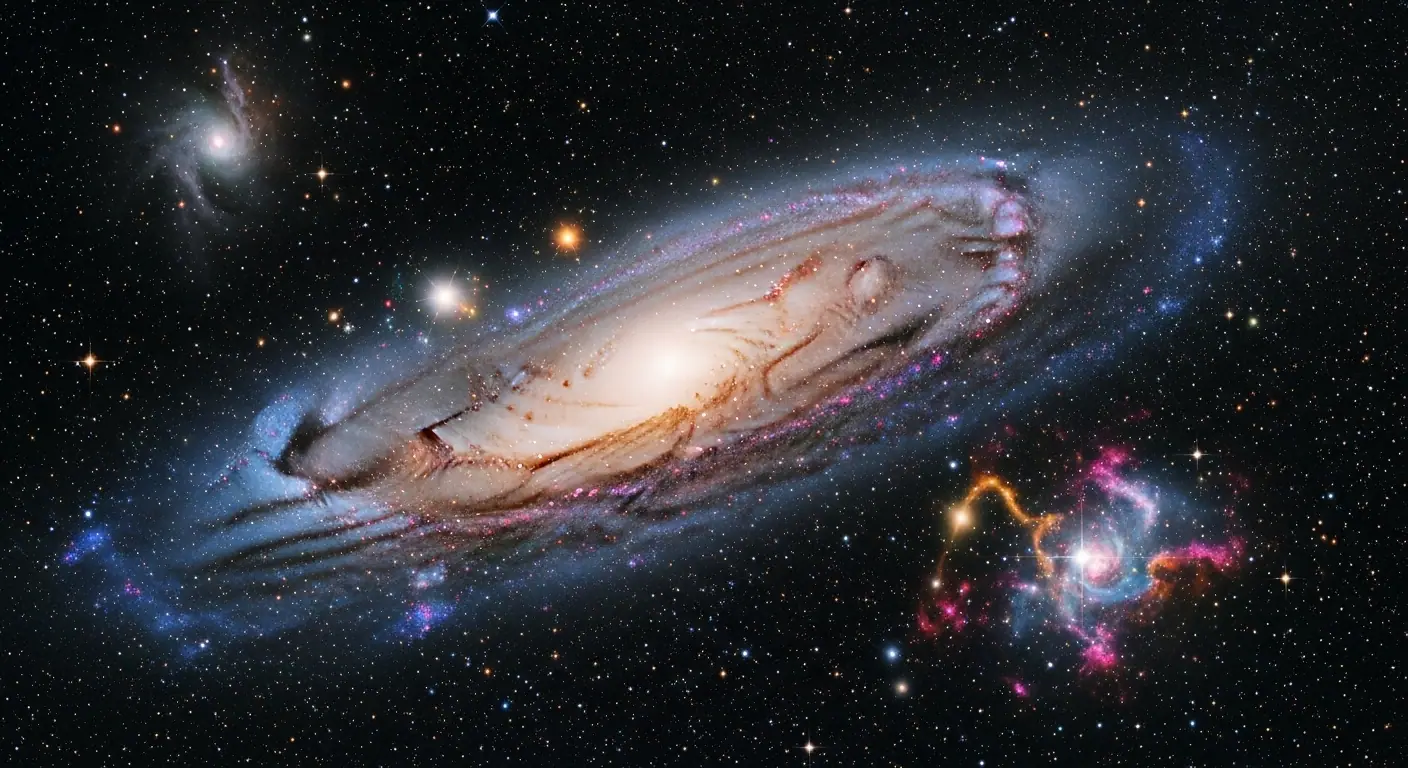
Andromeda Galaxy (M31) is the most distant object visible to the naked eye, at 2.5 million light-years. Through a small telescope, it appears as an elongated glow, brighter in the center and fading at the edges. You are seeing 200 billion stars as a faint smudge. A large aperture under dark skies begins to reveal its companion galaxies and hints of dust lane structure.
Essential Accessories
Most beginner telescopes include one or two eyepieces with the purchase. A few additional items will dramatically improve your experience.
Eyepieces. Eyepieces determine your magnification, calculated by dividing the telescope's focal length by the eyepiece's focal length. A typical beginner telescope might include a 25mm eyepiece (low power, wide field, excellent for star clusters and nebulae) and a 10mm eyepiece (higher power for planets). Adding a quality 6mm to 8mm eyepiece pushes useful magnification for planet viewing. Look for Plossl or wide-angle designs; avoid the cheap Huygens eyepieces that come with many budget scopes.
Barlow lens. A 2x Barlow lens doubles the effective focal length of any eyepiece, effectively doubling your magnification range. Insert your 25mm eyepiece into the Barlow and it becomes a 50mm equivalent; the 10mm becomes a 5mm equivalent. A quality Barlow costs $25 to $50 and essentially gives you twice as many effective eyepieces. It is one of the best-value accessories for beginners.
Red flashlight. Your eyes take 20 to 30 minutes to fully dark-adapt after leaving a lit environment. Any white light exposure resets this process. A red-light flashlight (or headlamp) preserves your night vision while allowing you to read star charts, adjust the telescope, and navigate safely in the dark. Do not use your smartphone screen without switching it to a dim red-light app.
Planisphere. A planisphere is a circular star chart with a rotating overlay that shows which constellations are visible for any date and time. They cost a few dollars and are more reliable than phones in cold weather. Combined with a free app like Stellarium or SkySafari for identifying specific objects, a planisphere covers all your sky navigation needs.
Apps for Stargazers
Stellarium (free, iOS and Android) is the gold standard free planetarium app. Point your phone at the sky and it overlays constellation lines, planet names, deep-sky objects, and satellite positions in real time. The desktop version (also free) is excellent for planning sessions in advance.
SkySafari (paid, multiple tiers) is the preferred app for serious observers. It includes a comprehensive database of objects, telescope control capabilities for motorized mounts, and detailed observing notes. The basic version is well worth the few dollars it costs.
Common Beginner Mistakes
Buying based on magnification. A telescope advertised as "450x power" is almost certainly a department-store instrument with a 60mm lens. Any telescope can theoretically achieve high magnification; what limits you is aperture. Judge telescopes by aperture in millimeters, not magnification numbers.
Observing from a lit room through the window. Glass windows distort light, and the temperature differential between a warm room and cold outside air creates turbulence that ruins the image. Always observe from outside with the telescope at ambient temperature. Give your scope 20 to 30 minutes to cool down to outside temperature before expecting sharp images.
Giving up after one bad night. Atmospheric "seeing" — the steadiness of the air above — varies enormously from night to night. A night of poor seeing makes even the best telescope look bad. Planets that look sharp on a night of good seeing are blurry smears on a night of turbulent air. If your first views are disappointing, try again on a different night. Cold, calm winter nights often offer the best seeing.
Ignoring the Moon in favor of "deep sky." Many beginners want to jump straight to galaxies and nebulae, only to be disappointed by faint smudges. The Moon, planets, and star clusters are the best objects for beginners — rewarding, easy to find, and impressive in any telescope. Master those first, then move to fainter targets as your skills and aperture grow.
Getting Started Tonight
If you are buying your first telescope, here is the simplest recommendation: if your budget is under $250, buy the Sky-Watcher Heritage 130P. If you want a GoTo mount and your budget is $400 to $600, buy the Celestron NexStar 4SE. If you want maximum aperture and are willing to learn the sky, save for the Sky-Watcher 8" Dobsonian. All three are genuine telescopes made by reputable companies with proper optics, not toy store disappointments.
Set up in your backyard on a clear night, point at the Moon, and look through the eyepiece. The universe is closer than you think, and it has been waiting for you to look up.