Black Holes: A Complete Guide to the Universe's Most Extreme Objects
From stellar-mass remnants lurking in our galaxy to the supermassive monsters anchoring galaxies across the cosmos, black holes are the universe's most extreme laboratories — and we are finally seeing them directly for the first time.
Black holes are regions of spacetime where gravity has become so extreme that nothing — not matter, not radiation, not light itself — can escape once it crosses a boundary called the event horizon. Once considered purely theoretical constructs, black holes are now confirmed astrophysical objects observed across a vast range of masses, from a few times the mass of our Sun to billions of solar masses lurking at the hearts of galaxies. In 2019 and 2022, humanity photographed two of them directly for the first time. The era of black hole astronomy has arrived.
What Is a Black Hole?
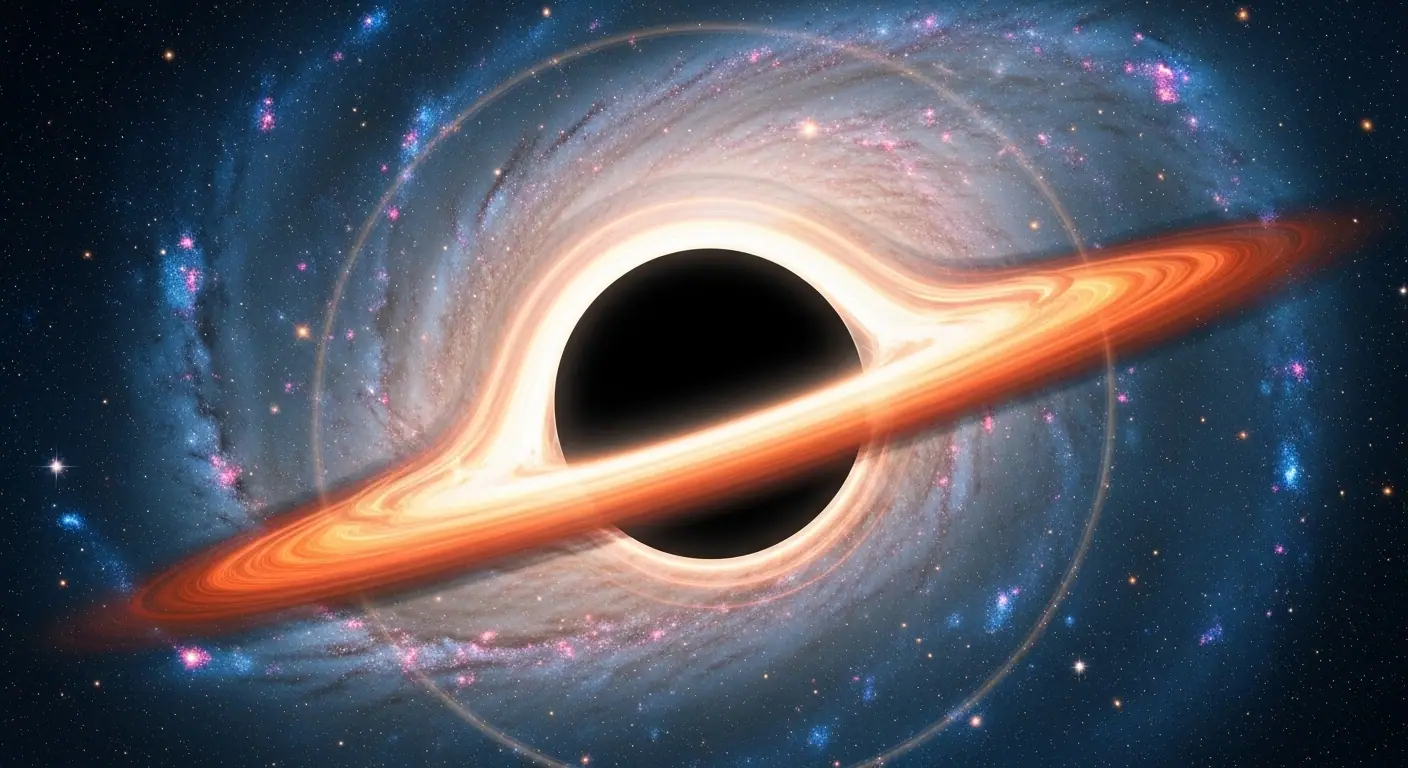
A black hole is defined not by what it contains but by what it does to the space and time around it. At its core lies a singularity, a point (or ring, for rotating black holes) where the known laws of physics break down and density becomes theoretically infinite. Surrounding the singularity is a region of normal space in which gravity is simply overwhelming. The boundary of this region — the point of no return — is the event horizon.
The event horizon is not a physical surface. An astronaut falling through one would feel nothing special at the moment of crossing; the horizon is invisible and has no material substance. What makes it special is purely geometrical: it marks the radius at which the escape velocity equals the speed of light. Below this radius, the curvature of spacetime is so severe that all possible future paths — every direction you could move — lead toward the singularity. There is no trajectory, no rocket thrust, nothing that can reverse the inward pull. Time itself, from the perspective of infalling matter, runs toward the singularity.
The radius of the event horizon for a non-rotating black hole is called the Schwarzschild radius, derived from Karl Schwarzschild's 1916 solution to Einstein's field equations. For a black hole with the mass of our Sun, the Schwarzschild radius is approximately 3 kilometers. For a supermassive black hole of 6.5 billion solar masses — the size of M87* — it is roughly 20 billion kilometers, larger than our entire solar system.
Types of Black Holes
Stellar-Mass Black Holes
Stellar-mass black holes form from the deaths of massive stars. When a star with more than roughly 20 times the mass of our Sun exhausts its nuclear fuel, the outward pressure that held it up against gravity vanishes. The core collapses catastrophically in a fraction of a second, triggering a supernova explosion that blasts the outer layers into space. If the remaining core mass exceeds approximately 3 solar masses — the Tolman-Oppenheimer-Volkoff limit — not even the quantum pressure of neutrons can halt the collapse, and a black hole forms. Stellar-mass black holes typically range from about 5 to roughly 100 solar masses, though the upper end of this range has been extended by recent gravitational wave detections.
Cygnus X-1, discovered in 1964 as an intense source of X-rays, was among the first objects seriously proposed as a black hole. It is a binary system in which a stellar-mass black hole of approximately 21 solar masses accretes material from a companion blue supergiant star. Gas stripped from the companion spirals inward through an accretion disk, heating to millions of degrees and radiating powerfully in X-rays before plunging through the event horizon. Cygnus X-1 became a landmark in astronomy — the subject of a famous 1974 bet between Stephen Hawking and Kip Thorne over whether it was truly a black hole (Thorne won; Hawking conceded in 1990).
Supermassive Black Holes
Supermassive black holes occupy the centers of virtually every large galaxy, with masses ranging from millions to tens of billions of solar masses. Their origin is less certain than that of stellar-mass black holes. They may have grown from smaller "seed" black holes through billions of years of mergers and accretion, or they may have formed directly from the collapse of massive primordial gas clouds in the early universe. The supermassive black hole at the center of our own Milky Way galaxy, known as Sagittarius A* (Sgr A*), has a mass of approximately 4 million solar masses and sits roughly 26,000 light-years from Earth. Despite its enormous mass by stellar standards, Sgr A* is relatively quiet compared to the active galactic nuclei of other galaxies, meaning it is currently accreting very little material.
Intermediate-Mass and Primordial Black Holes
Between the stellar and supermassive categories lies a poorly understood class: intermediate-mass black holes (IMBHs) with masses of hundreds to tens of thousands of solar masses. IMBHs are difficult to detect and confirm, but gravitational wave observations have provided evidence for their existence through mergers. Some dense stellar clusters appear to harbor IMBHs at their cores. Primordial black holes, hypothesized to have formed from density fluctuations in the very early universe, remain speculative but are considered candidates for contributing to dark matter if they exist in large numbers.
The Event Horizon and Spaghettification
For a stellar-mass black hole, the tidal forces near the event horizon are extreme. Tidal forces arise because gravity weakens with distance: the side of an object closer to the black hole is pulled more strongly than the side farther away. This differential stretching in the radial direction, combined with compression in the perpendicular directions, is called spaghettification. For a stellar-mass black hole, these tidal forces at the event horizon are strong enough to stretch a human body into a thin stream of particles long before crossing the horizon. For a supermassive black hole, however, the event horizon is so large that tidal forces at the horizon itself are relatively mild — an astronaut could cross the event horizon of a billion-solar-mass black hole without immediately experiencing any extraordinary sensation, though their fate would be sealed.
Astronomers have directly observed spaghettification in action through tidal disruption events (TDEs): occasions when a star wanders too close to a supermassive black hole and is torn apart by tidal forces. The disrupted star forms a stream of debris, roughly half of which falls back toward the black hole and creates a bright, months-long flare detectable across the universe. TDEs provide a way to detect otherwise dormant supermassive black holes in distant galaxies and study the accretion process in real time.
Hawking Radiation: Black Holes Are Not Forever
In 1974, physicist Stephen Hawking made one of the most surprising theoretical discoveries of the 20th century: black holes are not perfectly black. Quantum mechanical effects near the event horizon cause black holes to slowly emit thermal radiation, now called Hawking radiation, at a temperature inversely proportional to their mass. The more massive the black hole, the colder and dimmer its Hawking radiation. For stellar-mass and supermassive black holes, the Hawking temperature is fantastically small — far colder than the cosmic microwave background radiation that permeates the universe — meaning these black holes are absorbing far more energy from their environment than they emit, and will grow, not shrink, for the foreseeable cosmic future.
The mechanism arises from quantum field theory. Empty space is not truly empty; it seethes with virtual particle-antiparticle pairs that spontaneously appear and annihilate. Near the event horizon, one member of such a pair can fall into the black hole while the other escapes to infinity, carrying away energy. From a distant observer's perspective, the black hole appears to radiate. Over immense timescales, this process would cause a black hole to lose mass and ultimately evaporate entirely in a final burst of high-energy radiation. For a stellar-mass black hole, the evaporation timescale is approximately 10 to the power of 67 years — inconceivably longer than the current age of the universe. Hawking radiation has never been directly detected, but it is one of the most firmly grounded theoretical predictions at the intersection of quantum mechanics and general relativity, and its detection remains a key goal for future fundamental physics.
The First Images: M87* and Sgr A*
On April 10, 2019, the Event Horizon Telescope (EHT) collaboration released the first direct image of a black hole's shadow — a dark central region surrounded by a bright ring of glowing plasma. The target was M87*, the supermassive black hole at the center of the giant elliptical galaxy Messier 87, located 55 million light-years from Earth in the Virgo cluster. With a mass of 6.5 billion solar masses, M87* is one of the largest black holes known, and its event horizon is large enough — approximately 40 billion kilometers across — to be resolved from Earth using a network of radio telescopes spanning the entire planet.
The EHT is not a single telescope but a technique called very long baseline interferometry (VLBI). By synchronizing observations from radio telescopes on multiple continents — including dishes in Hawaii, Chile, Arizona, Spain, Antarctica, Mexico, and the South Pole — and combining the data using atomic clocks accurate to a single second in 100 million years, the EHT creates an effective telescope with an aperture equal to the diameter of Earth. At the millimeter radio wavelengths used by the EHT, this provides angular resolution sharp enough to read a newspaper in New York from Paris.
The 2019 M87* image showed a bright asymmetric ring with a darker region in the center — the black hole's shadow — exactly matching the predictions of general relativity. The brightness asymmetry arises because one side of the accretion disk is moving toward us (Doppler-brightened) and the other is moving away. In 2022, the EHT released the first image of Sgr A*, the black hole at the center of our own galaxy. Imaging Sgr A* was technically harder than M87* despite being far closer because Sgr A* is 1,500 times smaller in mass, meaning the gas orbiting it moves much faster, causing the image to change on timescales of minutes during the observations. Advanced computational techniques were required to capture a stable image. The result — another bright ring with a central shadow — again matched general relativistic predictions with remarkable fidelity, providing the strongest direct confirmation to date that the objects at galactic centers are indeed the black holes that Einstein's equations predict.
Gravitational Waves: Hearing Black Holes Collide
On September 14, 2015, the LIGO (Laser Interferometer Gravitational-Wave Observatory) detectors in Hanford, Washington, and Livingston, Louisiana, registered a fleeting distortion in the fabric of spacetime: the gravitational wave signal from two black holes merging 1.3 billion light-years away. The event, designated GW150914, confirmed a prediction of general relativity that had stood for exactly a century. Two black holes of approximately 29 and 36 solar masses had spiraled together over billions of years, finally merging in a collision lasting a fraction of a second, releasing more energy in gravitational waves than the entire visible universe emits in light — equivalent to roughly 3 solar masses converted directly to energy via E=mc².
LIGO detects gravitational waves by splitting a laser beam along two perpendicular 4-kilometer arms and looking for infinitesimal differences in the arrival time of the light as gravitational waves stretch and compress space. The displacements measured in GW150914 were approximately one-thousandth the diameter of a proton — an achievement of measurement that required decades of engineering refinement to reach the necessary sensitivity. By 2026, LIGO and its European partner Virgo, along with the KAGRA detector in Japan, have cataloged over 90 confirmed gravitational wave events, the vast majority from black hole mergers. These observations have revealed an entirely new population of black holes, including systems with masses in the range of 50 to 150 solar masses that were theoretically unexpected, and have provided precision tests of general relativity in the most extreme dynamical regime.
Looking ahead, the Laser Interferometer Space Antenna (LISA), a space-based gravitational wave detector approved by ESA and targeting launch in the mid-2030s, will open a new frequency window sensitive to the mergers of supermassive black holes across cosmic history. LISA will consist of three spacecraft flying in a triangular formation with arm lengths of 2.5 million kilometers, dwarfing the scale of any terrestrial detector. It will hear the gravitational wave "hum" of millions of compact binary systems and potentially detect signals from black hole mergers in the first billion years of the universe, providing an entirely new perspective on how supermassive black holes formed and grew.
What JWST Is Revealing About Black Holes
The James Webb Space Telescope has opened a new chapter in black hole research by peering back to the earliest epochs of the universe and revealing supermassive black holes that grew far faster and earlier than theory predicted. One of JWST's most provocative findings has been the detection of active galactic nuclei — luminous black holes accreting rapidly — within just a few hundred million years of the Big Bang. Several of these early black holes already appear to have masses of hundreds of millions of solar masses at a time when the universe was less than 5 percent of its current age. Standard models of black hole growth through gas accretion cannot easily explain this, even if seed black holes had formed immediately after the Big Bang and accreted at the maximum theoretically permitted rate continuously.
JWST is also transforming our understanding of how black holes co-evolve with their host galaxies. The relationship between a supermassive black hole's mass and the properties of its surrounding galaxy's stellar bulge — known as the M-sigma relation — suggests that black hole growth and galaxy growth are intimately linked through feedback processes in which jets and radiation from the active nucleus heat or expel the surrounding gas, regulating star formation. JWST observations of galaxies at high redshift are beginning to map this co-evolution directly, revealing cases where black hole feedback is quenching star formation in young galaxies and cases where the black hole is still building up rapidly alongside a prolific burst of star formation.
Webb's infrared sensitivity also enables the study of dust-obscured active galactic nuclei that are invisible to optical telescopes. Many of the most actively growing black holes in the early universe were buried within dense cocoons of dust that absorbed their ultraviolet and optical light and re-radiated it as infrared emission, precisely the wavelengths JWST is designed to detect. These observations are revealing a hidden population of rapidly growing black holes that had been missed by prior surveys, significantly revising upward the estimated number density of accreting black holes in the early universe.
Notable Black Holes
Beyond M87* and Sgr A*, a number of black holes have become landmarks in astronomy. TON 618 is among the most massive known, with a mass estimated at 66 billion solar masses, making it one of the largest single objects in the observable universe. Its event horizon radius exceeds the distance from the Sun to Neptune many times over. Arp 220, a merging pair of galaxies roughly 250 million light-years away, hosts two supermassive black holes on a collision course that will eventually produce a gravitational wave event detectable by LISA.
Closer to home, the Milky Way's stellar graveyard contains millions of stellar-mass black holes distributed throughout the galaxy. Most are completely invisible because they are not actively accreting; only those in binary systems that donate mass from a companion star, like Cygnus X-1, are detectable as X-ray binaries. The Gaia space astrometry mission has begun detecting black holes through their gravitational influence on companion stars — a purely dynamical technique that does not require any emission from the black hole itself — and is expected to catalog dozens or hundreds of such objects over the course of the mission.
Open Questions and the Frontier of Black Hole Physics
Despite dramatic progress, black holes remain one of the richest frontiers in fundamental physics. The information paradox — the question of whether information about matter that falls into a black hole is truly destroyed when the black hole eventually evaporates via Hawking radiation — remains one of the deepest unsolved problems at the intersection of quantum mechanics and gravity. General relativity, which is classical, says information is lost; quantum mechanics, which requires the preservation of information, says it cannot be. Resolving this paradox likely requires a complete theory of quantum gravity, which does not yet exist.
The nature of the singularity at the center of a black hole — where density becomes infinite and general relativity breaks down — is another outstanding mystery. Most physicists believe the singularity is not a physical reality but rather a signal that general relativity is an incomplete theory at the Planck scale, where quantum effects on spacetime cannot be ignored. Theories of quantum gravity, such as loop quantum gravity and string theory, offer different resolutions, but none has been tested experimentally. The interior of a black hole, causally disconnected from the outside universe, may remain permanently beyond empirical reach, making these questions as philosophical as they are scientific. Yet each new observation — each gravitational wave detection, each JWST image of an early-universe quasar, each EHT snapshot of an event horizon shadow — narrows the constraints on theories and edges us closer to understanding the most extreme objects the universe has produced.