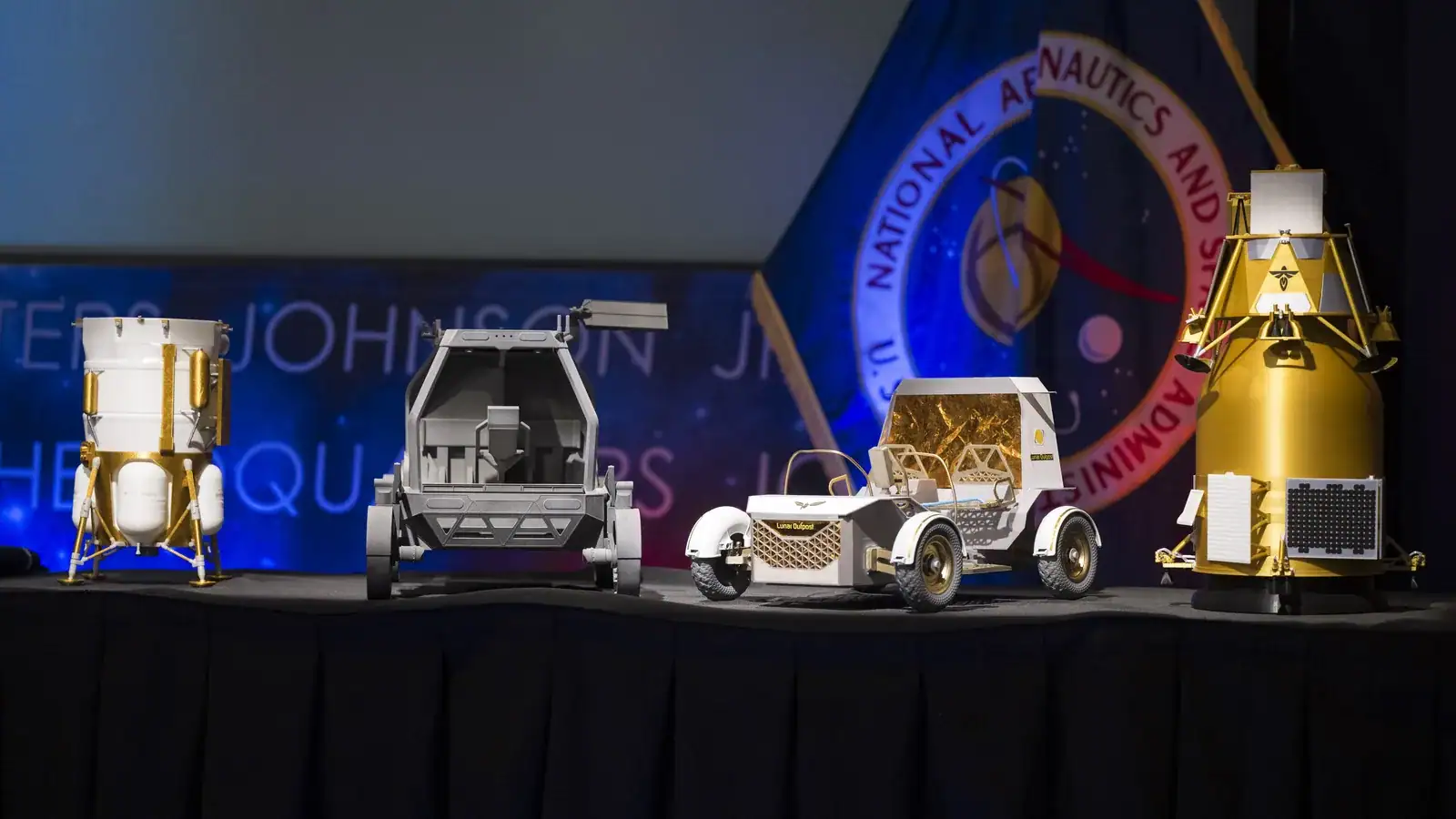
Blue Origin’s Blue Moon Mark 1 Endurance lander is targeted to launch no earlier than fall 2026, a swift timeline considering the complexities of lunar travel. The announcement came during a Moon Base event at NASA Headquarters, where agency leaders detailed new contracts for both crewed and uncrewed lunar rovers and landers. NASA Administrator Jared Isaacman stated that “The Moon Base will be America’s and humanity’s first outpost on another celestial world,” emphasizing the initiative’s scope beyond scientific discovery to encompass economic, technological, and interplanetary advancement. This first phase of missions, including the Blue Origin lander launch, will gather crucial operational data and mitigate risks before the arrival of Artemis astronauts.
Blue Origin’s Mark 1 Endurance for Moon Base I Missions
This delivery constitutes the initial phase of NASA’s Moon Base I initiative, designed to establish a sustained operational presence at the lunar South Pole. The announcement of these contracts and timelines occurred during a NASA event at headquarters on Tuesday, May 26, demonstrating the recent progression of these lunar development plans. Specifically, the Mark 1 Endurance will transport the Stereo Cameras for Lunar Plume-Surface Studies instrument, intended to analyze the interaction between lander thrusters and the lunar regolith; understanding this interaction is vital for mitigating dust hazards during future Artemis crewed landings. Alongside this, the lander will deploy a Laser Retroreflective Array, a tool that enables precise location determination for orbiting spacecraft via reflected laser signals, enhancing navigational accuracy. The chosen landing site, Shackleton Connecting Ridge, was selected to demonstrate capabilities that reduce risk for the crewed Artemis landing missions NASA is targeting for 2028.
This mission is not simply a technology demonstration, but a foundational step toward long-term lunar habitation. NASA describes Moon Base I as the first of more than a dozen missions the agency expects to announce this year, each designed to generate operational data and reduce risk ahead of crewed Artemis surface activities. The announcement does not attach a dollar value to the Mark 1 Endurance flight, describing the mission only in terms of the payloads it carries and the site it will reach. Together, the plume-surface cameras and the retroreflector address two practical questions that have to be answered before astronauts arrive: how much regolith a descending vehicle throws, and how precisely a spacecraft in orbit can fix a point on the ground below it.
Astrolab & Lunar Outpost Secure LTV Development Contracts
The lunar economy gained momentum as NASA revealed contracts awarded to Astrolab and Lunar Outpost for the development of Lunar Terrain Vehicles (LTVs), essential for establishing a sustained presence on the Moon. These awards, totaling $439 million, represent a decisive step beyond preliminary robotic missions and toward enabling extended crewed operations at the lunar South Pole. Astrolab received $219 million, while Lunar Outpost secured $220 million under the Phase 1 High Achievability Mission task orders of the Lunar Terrain Vehicle Services contract; the firm-fixed-price, performance-based milestones are intended to put crewed and uncrewed mobility systems on the lunar surface by 2028 through the Commercial Lunar Payload Services initiative. Astrolab’s offering, the Crewed Lunar Vehicle (CLV‑1), builds upon the company’s FLEX architecture, designed to transport astronauts, carry supplies, and support remote operations, with a stowed mass of about 2,000 pounds and the ability to reach more than 6 miles per hour on level terrain.
Complementing this, Lunar Outpost’s Pegasus rover is a lighter, mission-ready evolution of its Eagle model, tailored to meet NASA’s updated crewed LTV requirements. NASA says Pegasus is operational for up to a year and capable of manual, autonomous, or teleoperated driving at speeds of more than 9 miles per hour, drawing on Apollo-heritage technologies and prior prototype and flight experience to deliver human-centered mobility. The deployment of multiple LTVs early in the Moon Base development is intended to accelerate technology validation, refine site planning, and reduce operational hazards ahead of crewed Artemis missions. Over the next eighteen months, both companies will finalize rover designs, conduct crewed evaluations, and qualify flight units for operational readiness, supporting autonomous traverses, terrain preparation, and scientific investigations. NASA anticipates expanding opportunities for additional vendors through on-ramp competitions, fostering a robust and sustainable approach to lunar mobility.
Getting those rovers to the surface is a separate line of business, and it is the one Blue Origin won. To deliver the rovers to the Moon’s South Pole region, NASA awarded the company $188 million, with an option period worth a further $280.4 million, across two task orders. The competitive procurement was executed under the CLPS 1.0 indefinite-delivery/indefinite-quantity framework as the CX-2 task order, and NASA says it can choose to extend the task order for payload delivery, with the option period contingent on performance during the initial phase.
“Every mission, crewed and uncrewed, will be a learning opportunity as we return to the lunar surface, build the infrastructure to stay, and master the skills required to live and operate in one of the most demanding and dangerous environments imaginable,” said NASA Administrator Jared Isaacman. These contracts signal a clear commitment to building not just a temporary lunar outpost, but a permanent and operational base for scientific discovery and resource utilization.
The Moon Base will be America’s and humanity’s first outpost on another celestial world.
Moon Base II & III: Cargo Delivery and Lunar Research
Astrolab, a company specializing in lunar mobility, is currently preparing to deliver a crucial component of NASA’s Moon Base initiative: the FLIP rover. This uncrewed robotic platform, planned for launch via Astrobotic’s Griffin lander later this year as part of Moon Base II, will serve as a testbed for technologies intended for future lunar terrain vehicle operations. The mission will deliver over 1,100 pounds of cargo, maturing mobility systems essential for extended human presence on the lunar surface. This delivery is not simply about deploying a rover, but a vital step in validating the functionality and reliability of equipment designed to support astronauts exploring the Moon’s South Pole. Complementing Astrolab’s efforts, Intuitive Machines’ Nova-C Trinity lander will host the Lunar Vertex investigation, the primary payload selected through NASA’s Payloads and Research Investigations on the Surface of the Moon initiative as part of Moon Base III.
Also targeted for launch this year, Lunar Vertex will focus on studying lunar swirls, distinctive light-colored features on the Moon’s surface, to enhance understanding of surface evolution and material behavior under extreme conditions. This mission notably includes contributions from the European Space Agency and the Korea Astronomy and Space Science Institute, demonstrating the international scope of the Moon Base program.
Early surface mobility is a foundational component of the national space policy priority to create an enduring lunar presence.
NASA
MoonFall Drones and CLPS 2.0 Expand Lunar Capabilities
Beyond the initial lander deployments, NASA is rapidly expanding lunar surface capabilities through a combination of robotic drones and a revamped Commercial Lunar Payload Services program. The agency detailed plans for MoonFall, a mission targeted for launch in 2028 that will send four drones to survey potential landing sites for Artemis astronauts. NASA’s Jet Propulsion Laboratory in Southern California has been developing the design and testing prototype hardware, and has selected Firefly Aerospace to build the spacecraft that carries the drones from Earth orbit to the Moon. Once there, the drones will land independently and fly short hops across the surface, gathering high-resolution imagery of hard-to-reach terrain over the course of a single lunar day; after each drone’s final flight, its survive-the-night payload is designed to keep operating for several months. Further bolstering these efforts is the evolution of the CLPS program into CLPS 2.0. This next phase offers increased flexibility, allowing NASA to either order complete delivery services or integrate CLPS-delivered hardware into its own missions.
The final request for proposal for CLPS 2.0 was released on May 15, with responses due on Tuesday, June 30, signaling a continued commitment to commercial partnerships. These combined initiatives demonstrate a shift towards a more robust and versatile lunar exploration strategy, extending beyond single landing sites and paving the way for sustained operations at the Moon’s South Pole.