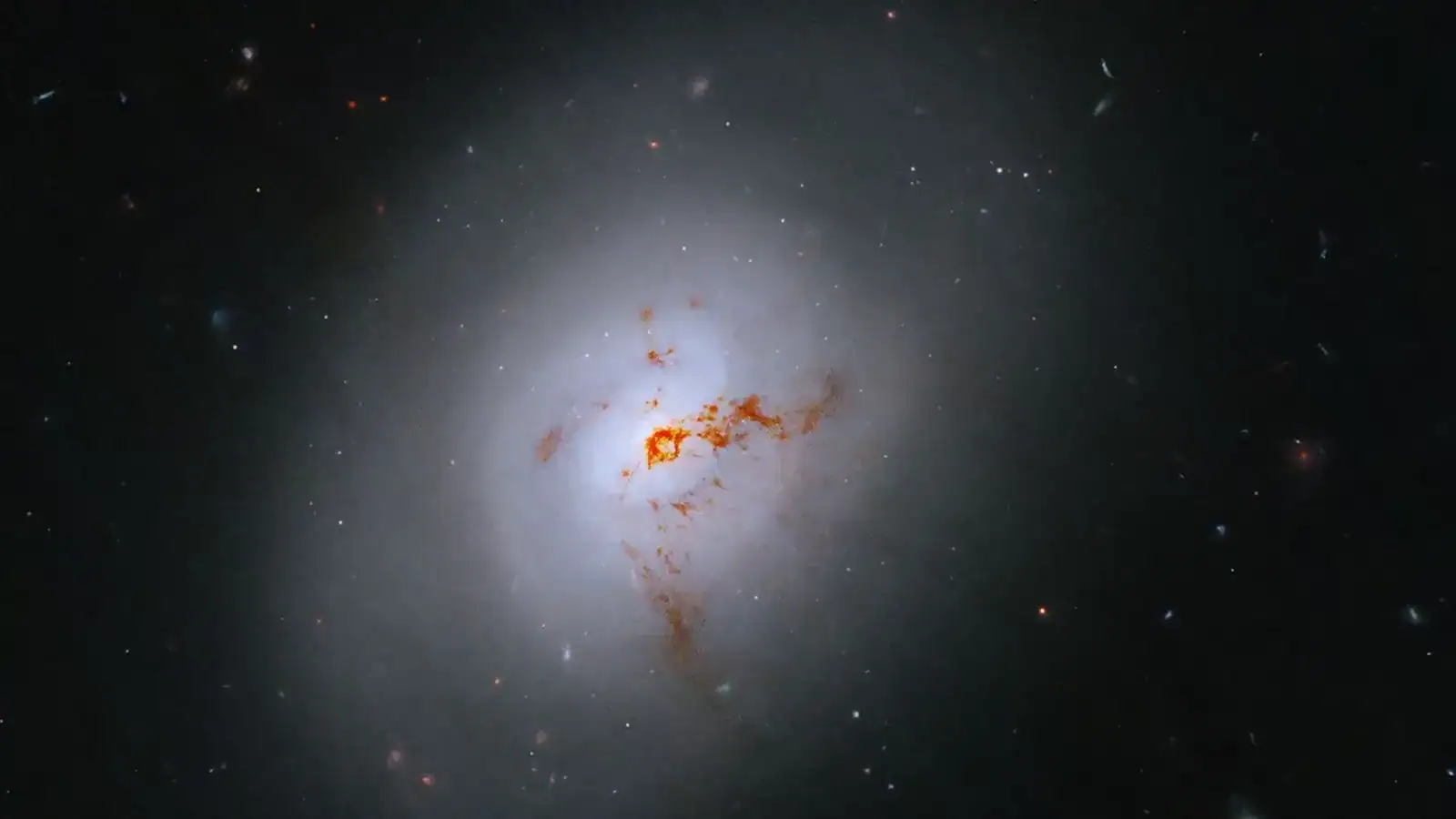
Hubble has captured a striking image of NGC 1266, a lenticular galaxy 100 million light-years distant in the constellation Eridanus, revealing a structure in transition. This enigmatic galaxy presents a bright center and a face that hints at spiral structure, yet it holds no discernable spiral arms, classifying it as an evolutionary bridge between spiral and elliptical forms. Reddish-brown clumps of dust partially obscure NGC 1266’s face, while light from more distant galaxies shines through its outer regions. Astronomers classify NGC 1266 as a rare post-starburst galaxy, one that experienced a major burst of star formation before entering a quieter phase; roughly one percent of local galaxies share this characteristic. Researchers believe a minor merger approximately 500 million years ago triggered these changes, funneling gas into the galaxy’s supermassive black hole and potentially suppressing future star birth.
NGC 1266 Galaxy: A Post-Starburst Transitional Structure
NGC 1266 is designated as a post-starburst lenticular galaxy, residing 100 million light-years distant within the constellation Eridanus, and presents a unique case for understanding galactic evolution. Unlike typical spirals, lenticular galaxies lack prominent spiral arms and demonstrate minimal ongoing star formation, instead resembling the smoother profile of ellipticals. However, NGC 1266’s most compelling characteristic is its status as a post-starburst galaxy, representing a fleeting phase between intense star formation and quiescence; only roughly one percent of nearby galaxies currently exhibit this transitional state. This increased activity generated powerful winds and jets, ultimately depleting the galaxy’s gas reserves and suppressing further star formation. Hubble observations reveal a strong outflow of gas and highly disturbed interstellar space, with any remaining stellar nurseries now confined to the galactic core; researchers have found very little to no star formation happens beyond that core. This suggests the central black hole actively suppresses star birth by ejecting star-forming gas, creating turbulence that prevents gravitational collapse, making NGC 1266 an ideal subject for studying the complex processes that regulate galactic evolution.
Hubble Observations Reveal Active Galactic Nucleus Processes
Classified as a post-starburst galaxy, NGC 1266 occupies a transitional phase between actively forming spirals and quiescent ellipticals; it exhibits a bright central bulge and flattened disk, yet conspicuously lacks the spiral arms characteristic of its earlier form. This unusual morphology, coupled with observations of disturbed interstellar space, suggests a complex history shaped by both stellar birth and energetic feedback from its active galactic nucleus. The NASA Hubble Mission Team explains that the additional matter made the black hole more active, detailing how this activity generated powerful winds and jets along the galaxy’s rotational axis. These outflows, combined with the consumption of gas by newly formed stars, have effectively depleted the reservoir of material needed for continued star birth, confining any remaining stellar nurseries to the galactic core. Researchers note that these observations suggest the supermassive black hole in the galaxy’s heart may be suppressing star birth, highlighting the importance of studying such galaxies to understand the interplay between black holes and their host galaxies.
Post-starburst galaxies have a young population of stars but few star-forming regions.
Lenticular Galaxies & Suppression of Star Formation
Astronomers classify these “lens-shaped” galaxies as bridging the gap, possessing a central bulge and flattened disk but lacking the active star birth regions common in spirals. Roughly one percent of galaxies in our local universe fall into this category, making NGC 1266 a valuable subject for understanding how star birth can be effectively suppressed. Remaining stellar nurseries are now confined to the galaxy’s core, with minimal star formation occurring beyond it, suggesting the black hole actively strips away star-forming material. These observations provide crucial insights into the complex interplay between supermassive black holes and their host galaxies, and how they regulate galactic evolution.