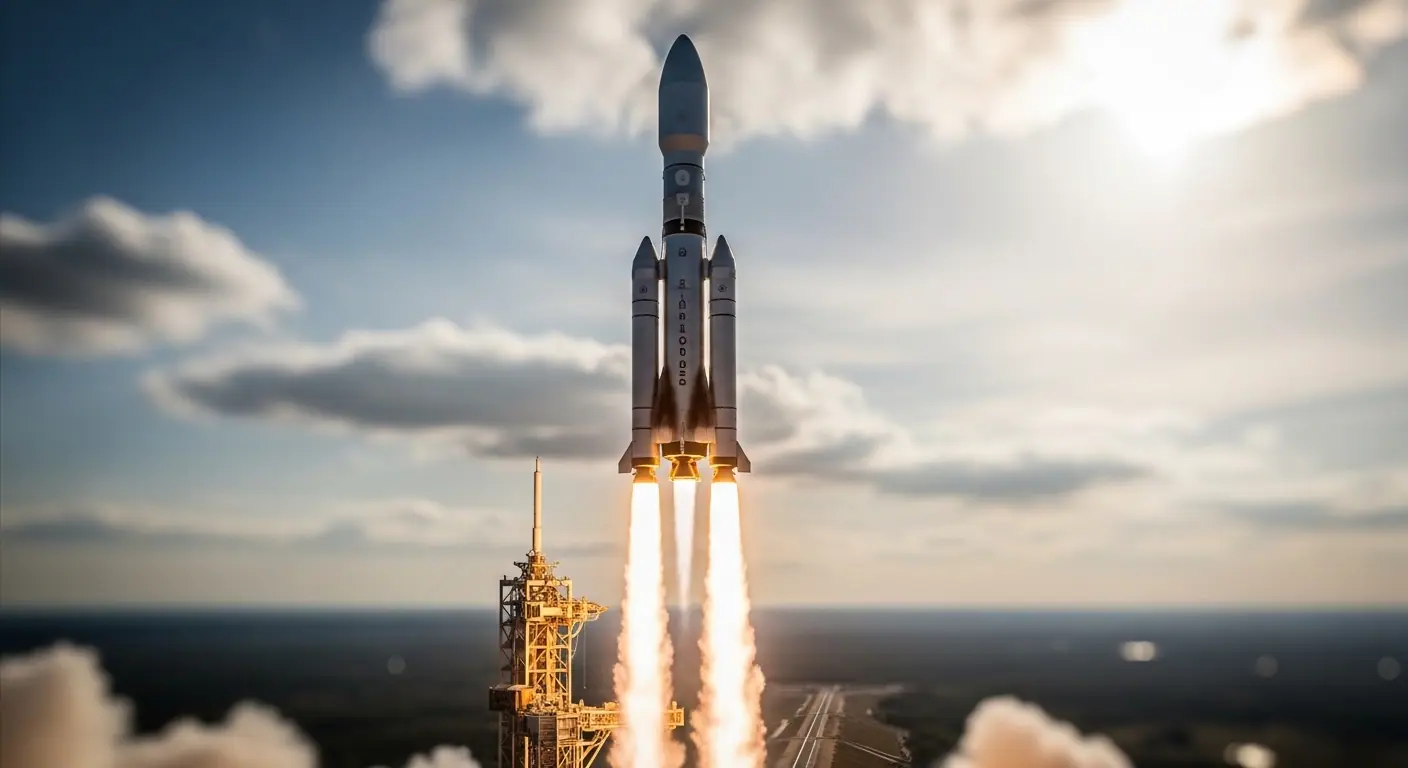
New Glenn: Blue Origin's Path to Reusability
From its debut orbital success in January 2025 to the first booster reuse on April 19, 2026 — a deep dive into New Glenn's rapid development, NG-3's BlueBird mission, and what comes next for Blue Origin's heavy-lift workhorse.
Blue Origin's New Glenn rocket has compressed a remarkable amount of progress into a short time. Fifteen months after its debut orbital flight in January 2025, the vehicle has now flown three times — and on its third flight, on April 19, 2026, it became only the second orbital-class rocket in history to successfully reuse its first-stage booster for a paying customer mission. The milestone puts New Glenn squarely in competition with SpaceX's Falcon 9 for the growing commercial heavy-lift market, and the pace of Blue Origin's execution suggests the company is finally shifting from patient development to aggressive operations.
New Glenn: The Rocket
New Glenn is a two-stage heavy-lift launch vehicle named for John Glenn, the first American to orbit Earth. Standing 98 meters tall with a 7-meter diameter, it is one of the largest operational rockets in the world. The first stage is powered by seven BE-4 engines — Blue Origin's own oxygen-rich staged combustion methane engines, also used to power United Launch Alliance's Vulcan Centaur. The second stage uses two BE-3U hydrogen-fueled engines for upper-atmosphere and vacuum performance.
New Glenn's defining competitive advantage over most of its rivals is payload volume. Its 7-meter fairing is the largest of any operational rocket, providing roughly twice the usable interior volume of a Falcon 9 fairing and comparable to the capacity planned for Starship. For satellite operators who have historically been constrained to design around smaller fairings, New Glenn opens up form factors that were previously impractical.
- Height: 98 meters (322 feet)
- Diameter: 7 meters (23 feet)
- Payload to LEO: ~45 metric tons (expendable)
- Payload to GTO: ~13 metric tons
- First stage engines: 7 × BE-4 (methane/LOX)
- Second stage engines: 2 × BE-3U (hydrogen/LOX)
- First stage reuse target: 25+ flights
NG-1: Debut Success
New Glenn's first flight launched on January 13, 2025, from Launch Complex 36 at Cape Canaveral Space Force Station. The mission, carrying Blue Origin's own Blue Ring orbital transfer vehicle as a demonstration payload, successfully reached orbit on its first attempt — a feat that has eluded the debut flights of many much-lauded rockets. Only a handful of rockets in history have achieved orbit on their maiden flight, and New Glenn joined that exclusive company.
The first stage booster, however, did not survive NG-1. Blue Origin attempted a drone ship landing but the booster was lost at sea. Blue Origin acknowledged the outcome, describing it as an acceptable result for a debut flight where reaching orbit was the primary objective. The booster loss was attributed to several factors related to the as-yet-uncharacterized flight environment, and the data from the descent was used to refine landing algorithms for subsequent flights.
The mission generated enormous attention in the launch industry. Blue Origin had been accused for years of moving too slowly relative to SpaceX, and a successful debut orbital flight was seen as proof that the company had turned a corner. Customers who had signed contracts contingent on successful flights began firming up their launch schedules.
NG-2: First Booster Recovery
New Glenn's second flight, NG-2, launched in September 2025 carrying a commercial GEO communications satellite. The mission represented Blue Origin's first operational revenue-generating launch under the New Glenn manifest. More significantly, NG-2 was the first mission on which Blue Origin successfully recovered the first-stage booster.
The booster, known as "So You're Telling Me There's a Chance," landed on Blue Origin's drone ship "Jacklyn" — named after Jeff Bezos's mother — in the Atlantic Ocean approximately 450 kilometers downrange from the launch site. The landing, executed using the same vertical propulsive descent technique pioneered by Falcon 9, came after a boostback burn, a re-entry burn to slow the booster from peak velocity, and a terminal landing burn that brought it to a controlled touchdown on the ship's deck.
Blue Origin's engineering team then spent the months between NG-2 and NG-3 inspecting the recovered booster in detail. The inspection informed decisions about which components could be reflown as-is, which required refurbishment, and which had experienced unexpected wear. This data-gathering was itself part of the reusability development process — understanding how the vehicle degrades across flights is essential for certifying a reflight timeline and cost model.
NG-3: First Booster Reuse — April 19, 2026
NG-3, launching today (April 19, 2026), is New Glenn's most significant mission to date. For the first time, Blue Origin is flying the same first-stage booster that landed after NG-2, making New Glenn only the second orbital-class rocket family in history — after Falcon 9 — to achieve first-stage reuse on a paying customer mission.
Payload: AST SpaceMobile BlueBird 7
The primary payload for NG-3 is BlueBird 7, a commercial satellite for AST SpaceMobile — the company building the world's first space-based cellular broadband network designed to communicate directly with standard unmodified smartphones. BlueBird 7 is one of the large-format Block 2 generation satellites in AST's constellation, featuring a deployable antenna array spanning approximately 64 square meters when fully deployed.
The choice of New Glenn as the launch vehicle for BlueBird 7 is commercially and symbolically significant. AST SpaceMobile has a multi-launch agreement with Blue Origin, and NG-3 is the first of those contracted missions. The large cross-sectional area of the BlueBird Block 2 satellites makes New Glenn's wide 7-meter fairing a practical necessity — the satellites are among the few payloads for which the fairing volume advantage is not just convenient but operationally required.
What Reuse Means for New Glenn's Economics
The economics of reusable rocketry depend on the ratio of refurbishment cost to new-build cost. For Falcon 9, SpaceX estimates that refurbishing a booster for its second flight costs roughly 10% of a new first stage — meaning that by the second flight, the amortized cost of the stage is approximately 55% of a new build (50% new + 10% refurb). By the fifth flight, the amortized cost per flight drops to around 22% of a new stage. This declining cost curve is why Falcon 9's pricing has remained competitive even as launch demand and SpaceX's operational overhead have grown.
Blue Origin is aiming for a similar curve with New Glenn. The company has not publicly disclosed its refurbishment cost targets, but industry estimates suggest that a mature New Glenn reuse program — achieving 10+ flights per booster — could bring the effective first stage cost per flight down to a level competitive with Falcon 9's demonstrated pricing. Achieving that maturity requires consistently landing and reflying boosters, which is exactly what NG-3 begins to demonstrate.
New Glenn vs. Falcon 9: An Honest Comparison
The inevitable comparison between New Glenn and Falcon 9 reveals a mix of New Glenn advantages and areas where Falcon 9 maintains a significant lead.
Where New Glenn Leads
- Fairing volume: New Glenn's 7-meter fairing provides approximately twice the usable volume of Falcon 9's 5.2-meter fairing, enabling payload designs that are physically impossible on Falcon 9.
- GTO capability: New Glenn can deliver approximately 13 metric tons to geostationary transfer orbit, compared to Falcon 9's approximately 8 mt (in expendable mode). For heavy GEO communications satellites, New Glenn's mass advantage is substantial.
- Engine technology: The BE-4's full-flow staged combustion cycle is thermodynamically more efficient than Falcon 9's gas-generator Merlin engines, providing a performance foundation for future upgrades.
Where Falcon 9 Leads
- Flight heritage: Falcon 9 has over 350 successful flights and an established track record of booster reuse up to 25+ times. New Glenn has three flights. This gap in reliability statistics matters enormously to risk-averse customers, particularly the U.S. government and high-value GEO operators.
- Launch cadence: SpaceX regularly launches Falcon 9 multiple times per week. New Glenn is launching multiple times per year. Until New Glenn's cadence increases substantially, customers with time-sensitive launch needs have limited flexibility.
- Price: Falcon 9 has driven commercial launch prices down to approximately $60-70 million for a dedicated LEO mission. New Glenn's pricing is not publicly detailed, but with fewer flights and a newer infrastructure, it is unlikely to undercut Falcon 9 in the near term.
- Reuse depth: Falcon 9 has demonstrated boosters flying on their 20th+ missions. New Glenn is on its first reflight. The gap in refurbishment knowledge is enormous.
The BE-4 Engine: New Glenn's Foundation
At the core of New Glenn's competitive position is the BE-4 engine, which Blue Origin developed over more than a decade. The BE-4 is an oxygen-rich staged combustion engine producing approximately 2,400 kilonewtons of thrust, burning liquid methane and liquid oxygen. It is the first American-made oxygen-rich staged combustion engine to achieve operational flight status — a distinction that Russia's engine industry held essentially alone for decades.
The BE-4 powers New Glenn's first stage in a cluster of seven engines and also powers ULA's Vulcan Centaur rocket. This dual-program production run has allowed Blue Origin to spread engine development costs and build a production cadence that neither program could sustain alone. As both New Glenn and Vulcan increase their flight rates, BE-4 production will scale proportionally, driving down per-unit costs through manufacturing learning effects.
The engine's methane propellant choice is strategically aligned with the direction the industry is heading. Methane burns cleaner than kerosene (RP-1), reducing soot buildup in engines and making reuse refurbishment less intensive. SpaceX's Raptor and Blue Origin's BE-4 both use methane; ULA's VULCAN is the only BE-4 customer using it with a different upper stage propellant, while New Glenn maintains an all-methane first stage with a hydrogen upper stage.
New Glenn's Customer Manifest and Future
Beyond AST SpaceMobile, New Glenn has a growing manifest of government and commercial customers that will keep the vehicle busy as launch cadence increases.
Government Customers
New Glenn has achieved National Security Space Launch (NSSL) certification, qualifying it for U.S. Space Force missions. This places New Glenn in the exclusive pool of launch vehicles trusted with classified and high-value national security payloads, alongside SpaceX's Falcon 9/Heavy and ULA's Vulcan. NSSL missions provide reliable baseline revenue and institutional credibility that signals to commercial customers that the vehicle meets stringent reliability standards.
NASA selected New Glenn for the ESCAPADE mission, which will send two spacecraft to orbit Mars and study its magnetosphere. ESCAPADE is a relatively small scientific mission in mass terms, but its assignment to New Glenn is significant as a demonstration that the science community trusts the vehicle for interplanetary trajectories.
Commercial Customers
Amazon's Project Kuiper broadband satellite constellation represents potentially dozens of New Glenn missions. Amazon has contracted launches from multiple providers — Ariane 6, Vulcan, and New Glenn — for the initial Kuiper deployment, with New Glenn likely carrying a significant share. Kuiper's 3,236-satellite target constellation will require sustained launch activity across several years.
Telesat Lightspeed has contracted New Glenn for its next-generation LEO communications constellation. Eutelsat OneWeb is another contracted customer. The common thread among New Glenn's commercial customers is a preference for larger satellites or bulk deployments that benefit from the vehicle's fairing volume and GTO capability.
The Road Ahead
Blue Origin's near-term operational goals center on building launch cadence and extending booster reuse. The company has indicated a target of six or more New Glenn flights in 2026, which would represent a significant step up from the three flights across 2025 and early 2026. Achieving that cadence requires not just hardware production but the operational systems — range scheduling, ground crew training, propellant logistics, and recovery ship operations — to support a true operational launch service rather than an experimental program.
Longer-term, New Glenn's architecture is designed to be upgraded. Blue Origin has studied a New Glenn variant with improved second-stage performance for missions requiring higher energy orbits. The eventual "Jarvis" concept — a fully reusable second stage — would allow New Glenn to approach the cost model of a completely reusable system, though this remains a development aspiration rather than a near-term program.
Today's NG-3 launch, with its reused booster and commercial AST SpaceMobile payload, represents the first day of New Glenn as a mature operational launch system rather than a development program. The gap between New Glenn and Falcon 9 remains wide, but for the first time it is measurably narrowing.
Explore Blue Origin and Launch Providers
Dive deeper into Blue Origin's full program portfolio and how New Glenn compares to the competition.