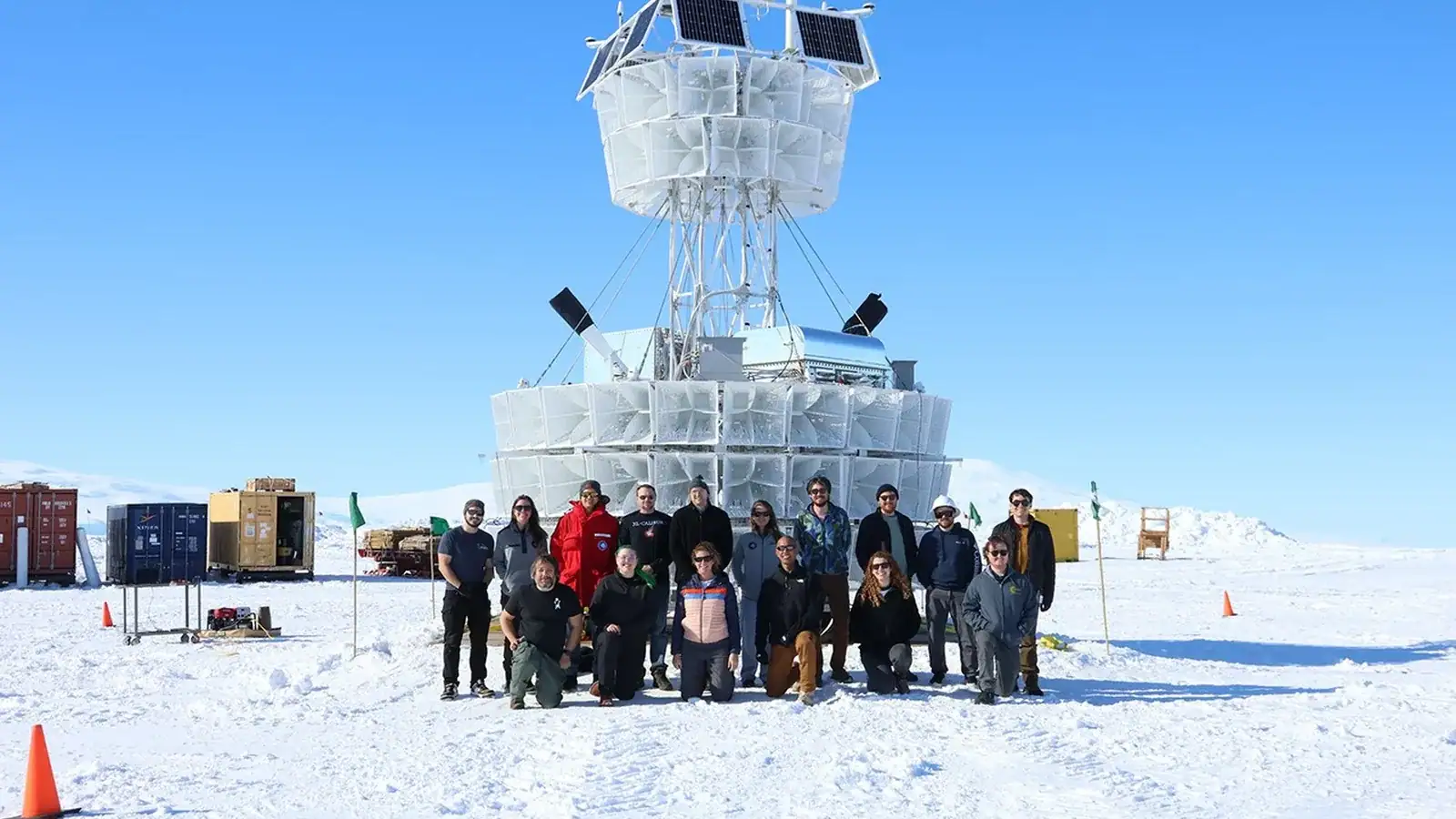
NASA’s Payload for Ultrahigh Energy Observations (PUEO) employed an unconventional detection method, utilizing the Antarctic ice sheet as a massive volume to search for elusive radio signals from ultra-high energy neutrinos. The mission, funded by the Astrophysics Pioneers Program and launched in December from the Long Duration Balloon Facility near McMurdo Station, Antarctica, flew for 23 days before a successful recovery approximately 120 miles (200 km) from the South Pole. PUEO targeted neutrinos originating from extreme cosmic events like supermassive black holes and neutron star mergers, and also detected radio signals from high-energy cosmic ray air showers, either directly or through reflection off the ice. This sensitivity was achieved through a new interferometric phased array trigger, allowing the instrument to detect weaker signals than previously possible by lowering the detection threshold. Analysis of the collected data is underway, promising insights into the origins of the highest-energy cosmic rays and fundamental physics beyond current accelerator capabilities.
Antarctic Ice Sheet as Detection Volume for Ultrahigh Energy Particles
Unlike traditional detectors relying on contained volumes of liquid or solid material, PUEO leveraged the vastness of the ice, monitoring for radio signals generated as these particles traversed it. This allowed the instrument to search for signals across an immense volume, effectively turning the continent into a cosmic particle observatory. The mission, funded by NASA’s Astrophysics Pioneers Program, utilized a Long Duration Balloon (LDB) platform, demonstrating a comparatively low-cost method for investigating extreme astrophysical phenomena. The team doubled the antenna collecting area for frequencies above 300 MHz compared to the earlier ANITA mission, further enhancing sensitivity. To accommodate these improvements within the LDB’s launch constraints, the PUEO team increased the low-frequency cutoff of the antennas, enabling smaller designs. A deployed low-frequency instrument extended the sensitivity down to 50 MHz, improving detection of extensive air showers; researchers suggest that many of the technology advancements developed for PUEO may also be applicable for mission concepts under development that would use the lunar regolith as a detector for ultra-high energy cosmic rays, indicating a potential future for this detection method beyond Earth’s poles.
Interferometric Triggering Lowers PUEO’s Detection Threshold
A key advancement enabling PUEO’s increased sensitivity was the implementation of a new interferometric phased array trigger, coherently summing signals from multiple antennas in real time. Maintaining a compact payload within the LDB’s launch constraints required innovative solutions. The combined effect of these technologies promises a wealth of new data, as lowering the trigger threshold allowed PUEO to detect weaker neutrino and cosmic-ray signals than previous experiments, offering insights into the origins of the most energetic particles in the universe and testing fundamental physics at extreme energy levels.
By lowering the trigger threshold, PUEO could dig further into the noise, and find weaker neutrino and cosmic-ray signals than previous experiments.
The development of PUEO’s detection capabilities hinged on innovations in antenna technology, spearheaded by researchers aiming to expand the range of observable cosmic phenomena. A significant improvement in sensitivity compared to its predecessor, ANITA, stemmed from a new trigger system. Maintaining a compact payload for the LDB launch proved challenging, prompting a strategic increase in the low-frequency cutoff of the antennas, resulting in smaller overall dimensions.