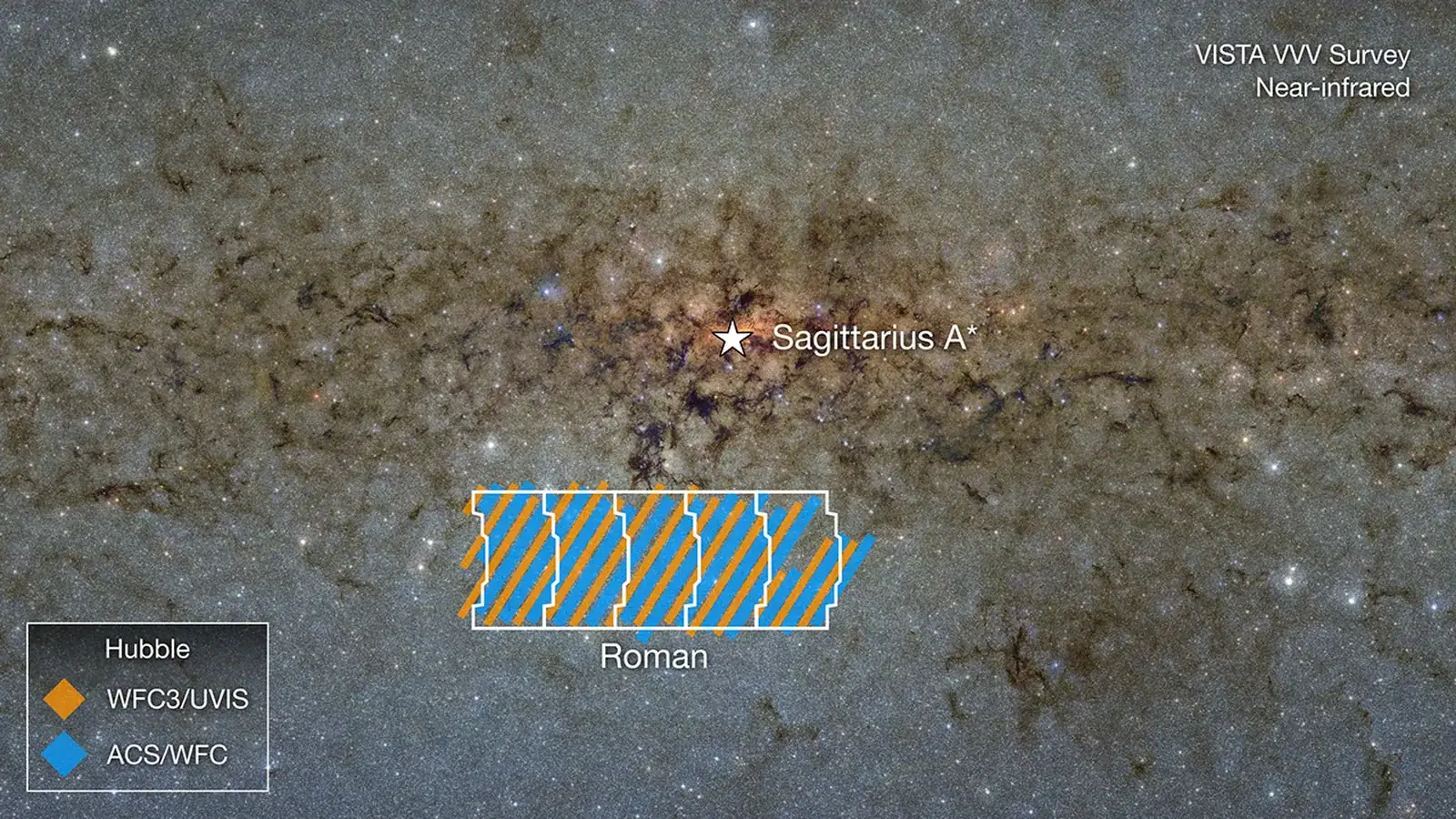
A detailed image from the VISTA VVV Survey shows the galactic bulge surrounding Sagittarius A*, the supermassive black hole at the Milky Way’s center, and outlines a region specifically targeted for upcoming observations by NASA’s Nancy Grace Roman Space Telescope. Building on decades of study with telescopes including Hubble and James Webb, Roman will prioritize characterizing this dense stellar environment as a core science objective, surveying millions of stars at a faster rate than previous observatories. To prepare for this undertaking, astronomers utilized the Hubble Space Telescope to observe the same areas Roman will cover in its Galactic Bulge Time-Domain Survey, enabling more accurate interpretation of future data. “A top priority of our Hubble survey is to cover as much sky area as possible,” said Sean Terry, project lead and assistant research scientist from the University of Maryland, College Park and NASA’s Goddard Space Flight Center in Greenbelt.
Hubble & Roman Collaboration for Galactic Bulge Time-Domain Survey
This region, already extensively mapped by the VISTA VVV Survey, shows the area targeted by a dedicated time-domain survey designed to characterize a vast population of stars, planets, and compact objects previously hidden from view. This collaboration is not simply two telescopes looking at the same area; Hubble is actively preparing the ground for Roman’s more comprehensive investigation, establishing a crucial baseline of data. Astronomers leveraged Hubble’s capabilities to conduct a large-scale survey, which began in the spring of 2025, covering much of the area Roman will target in its Galactic Bulge Time-Domain Survey. This proactive approach addresses a key challenge in interpreting Roman’s observations: disentangling the light from lensing objects from the background stars they warp. By identifying these light sources before microlensing events occur, the team aims to significantly improve the accuracy of Roman’s data analysis.
The scale of this Hubble program surpasses two previous surveys, each covering around 0.5 square degrees, resulting in a dataset larger than the decade-long effort to assemble Hubble’s mosaic of the Andromeda galaxy. The primary scientific goal is to utilize microlensing, a phenomenon where gravity bends and magnifies light from distant stars, to detect exoplanets and other faint objects. This technique is particularly effective in the galactic bulge due to its high stellar density. Roman’s wide field of view and rapid cadence, a snapshot every 12 minutes over 72-day observing seasons across approximately 1.7 square degrees, will allow it to monitor millions of stars and identify thousands of these subtle lensing events.
However, the true power lies in combining this with Hubble’s preparatory work. “The main goal of these observations is to be able to identify objects that participate in lensing events during the Roman survey, catching them before they undergo the lensing event,” said Jay Anderson of the Space Telescope Science Institute in Baltimore. This synergy will move beyond simply detecting exoplanets to characterizing them with unprecedented precision.
While microlensing typically yields a ratio of the masses of a star and its planet, the addition of pre-event Hubble data will allow scientists to determine the individual masses of the stars involved. Terry said, “Instead of estimating a mass ratio of a planet that's orbiting a star, we can say that we're confident it's a Saturn-mass planet orbiting a star that's 0.8 solar masses.” He continued, “With the help of precursor imaging from Hubble you can hope to get direct measurements of the masses as opposed to indirect mass ratios.” The team anticipates Roman will expand upon Hubble’s star catalog by an order of magnitude, potentially measuring millions of stars more than Hubble’s 20 to 30 million point sources. Anderson added, “The great thing about microlensing is that we’ll be able to do a complete census of objects as small as Mars that are moving between us and these fields in the bulge, no matter what it is.”
Microlensing Technique Detects Rogue Planets and Neutron Stars
The search for exoplanets and compact stellar remnants has entered a new phase, leveraging the power of microlensing with a strategic preparatory campaign utilizing both the Hubble and Nancy Grace Roman space telescopes. This proactive approach is not simply about observing the same area; it’s about establishing a detailed baseline understanding of the stars before Roman begins its primary observations, a crucial step for accurate analysis. The galactic bulge, a densely packed stellar environment, is ideally suited for microlensing studies. This technique relies on the gravitational warping of light from distant stars by intervening objects, allowing the detection of otherwise invisible entities like rogue planets, those ejected from their original star systems, and isolated neutron stars. Roman’s Galactic Bulge Time-Domain Survey will systematically monitor a substantial area, approximately 1.7 square degrees.
This rapid cadence is essential for catching the fleeting signals of microlensing events, which occur on the scale of individual stars rather than entire galaxies. Deciphering these events, however, requires knowing the characteristics of the lensing object and the background star. Identifying these light sources before a microlensing event occurs significantly simplifies the analysis, and Hubble’s contribution is critical; the telescope has been systematically surveying the planned Roman observation area, building a comprehensive catalog of stars. The resulting data will allow scientists to move beyond simply measuring mass ratios between stars and planets to determining absolute masses.
The main goal of these observations is to be able to identify objects that participate in lensing events during the Roman survey, catching them before they undergo the lensing event.
Hubble Precursor Data Enables Precise Stellar Mass Measurements
The team’s work, detailed in a recent paper published in the Astrophysical Journal, focuses on identifying stars before they participate in microlensing events, a technique central to Roman’s exoplanet hunting strategy. The galactic bulge, a region brimming with stars and interstellar dust, presents unique challenges for exoplanet detection. Roman’s Galactic Bulge Time-Domain Survey will utilize microlensing, where the gravity of a foreground star bends and magnifies the light of a background star, revealing the presence of orbiting planets. However, accurately characterizing these planetary systems requires precise knowledge of the host star’s mass. Hubble’s contribution lies in providing pre-event images, allowing astronomers to distinguish the lensing star from the background source before the magnification occurs. This preparatory work is significantly more extensive than previous efforts; the current program surpasses two earlier surveys, each covering around 0.5 square degrees, which together produced Hubble’s largest mosaic, that of the neighbouring Andromeda galaxy.
The Roman telescope team is targeting an area of approximately 1.7 square degrees, observing it over six 72-day seasons with snapshots taken every 12 minutes. The resulting data will allow for a far more accurate determination of stellar masses than previously possible, moving beyond estimations of mass ratios to direct measurements. This leap in precision is achieved by combining Hubble’s pre-event imaging with Roman’s observations, allowing scientists to confidently identify the characteristics of both the lensing star and the background source. The Hubble data will aid in mapping areas of extinction, dense clouds of dust and gas that obscure starlight, and will contribute to a comprehensive catalog of stars, expected to grow by an order of magnitude from 20 to 30 million sources identified by Hubble.
A top priority of our Hubble survey is to cover as much sky area as possible.
Sean Terry, project lead and assistant research scientist from the University of Maryland, College Park and NASA’s Goddard Space Flight Center in Greenbelt
Roman’s Survey to Expand Star Catalogs by an Order of Magnitude
The coming flood of data from the Nancy Grace Roman Space Telescope promises to redefine our understanding of the Milky Way’s stellar population, and a crucial preparatory step has been undertaken by the Hubble Space Telescope to maximize the scientific return. The impact extends beyond exoplanet detection. Roman will add to Hubble’s catalog of 20 to 30 million point sources by an order of magnitude. The Roman telescope will survey approximately 1.7 square degrees, observing it over six 72-day seasons with snapshots taken every 12 minutes.
Instead of estimating a mass ratio of a planet that's orbiting a star, we can say that we're confident it's a Saturn-mass planet orbiting a star that's 0.8 solar masses, for example.