
INVAP
INVAP (Investigación Aplicada) is an Argentine state-owned high-technology company headquartered in San Carlos de Bariloche, Patagonia, and owned by the Río Negro provincial government — one of Latin America's most capable aerospace and nuclear technology organizations, with a satellite manufacturing program recognized internationally for delivering complex space systems to both domestic and export customers.
- Founded
- 1976
- Headquarters
- San Carlos de Bariloche, Argentina
- Ownership
- Subsidiary of Río Negro Province
Quick Facts
About INVAP
INVAP (Investigación Aplicada) is an Argentine state-owned high-technology company headquartered in San Carlos de Bariloche, Patagonia, and owned by the Río Negro provincial government — one of Latin America's most capable aerospace and nuclear technology organizations, with a satellite manufacturing program recognized internationally for delivering complex space systems to both domestic and export customers.
Founded in 1976 as a spin-off of the Argentine Atomic Energy Commission (CNEA), INVAP's original mandate was to design and manufacture research nuclear reactors. The company has since exported research reactors to Algeria, Egypt, Australia, Peru, and Saudi Arabia — a unique commercial achievement for a developing-nation nuclear technology exporter. This engineering culture of complex system integration transitioned naturally into satellite development as Argentina's space program expanded under CONAE (Comisión Nacional de Actividades Espaciales).
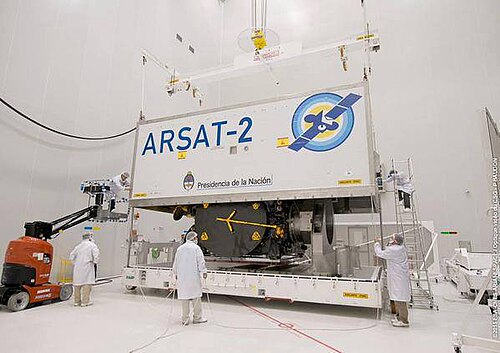
In the satellite domain, INVAP has manufactured SAOCOM 1A and 1B — twin L-band synthetic aperture radar (SAR) Earth observation satellites launched in 2018 and 2020 aboard SpaceX Falcon 9 rockets. SAOCOM is operated by CONAE and forms part of a bilateral Italian-Argentine SIASGE constellation with the Italian COSMO-SkyMed radar satellites, providing complementary L-band and X-band SAR coverage for flood mapping, soil moisture measurement, agricultural monitoring, and emergency response. L-band SAR penetrates cloud cover and vegetation canopy, making SAOCOM particularly valuable for tropical and polar-region land monitoring.
INVAP also manufactured the SAC-D/Aquarius satellite (launched 2011, a joint NASA-CONAE mission) that carried NASA's Aquarius instrument for global ocean salinity mapping alongside CONAE instruments for thermal radiation and microwave imaging. Additionally, INVAP built the SAC-A and SAC-C Earth observation satellites, establishing Argentina's continuity as one of the few developing nations with indigenous satellite manufacturing capability spanning optical, radar, and scientific payload platforms.
Team
- Conrado F. VarottoFounder · source
Signals
- Verification
- Verified 2026-09-05
Categories & Capabilities
Industry Categories
Location
Loading map...
Share
Suggest an Edit
Is this information outdated or incorrect? Help us improve this profile.
Submit CorrectionExplore More
Discover 1,000+ space companies worldwide
Similar Companies
Other companies in satellite-manufacturing
General Atomics EMS
General Atomics Electromagnetic Systems (GA-EMS) is a diversified technology company applying decades of research and de...
Innova Space
Innova Space is an Argentine commercial space company headquartered in Buenos Aires, developing the Libertadores de Amér...
Hanwha Aerospace
Hanwha Aerospace, publicly traded on the Korea Stock Exchange (ticker 012450.KS, ~$8B market cap), is South Korea's larg...
MDA Space
MDA Space (TSX: MDA) is a leading Canadian space technology company with over 50 years of heritage building systems that...
OHB SE
OHB SE is a German space technology company listed on Frankfurt Stock Exchange and headquartered in Bremen, Germany. Fou...
Turkish Aerospace
Turkish Aerospace Industries (TAI — TUSAŞ, Türk Havacılık ve Uzay Sanayii A.Ş.), headquartered in Ankara's Kahramankazan...
Also in Argentina
Other space companies based in Argentina
Related Articles
Industry analysis mentioning INVAP
Frequently asked about INVAP
Quick answers to the questions readers most often search for.
- When was INVAP founded?
- INVAP was founded in 1976 in Argentina.
- Where is INVAP headquartered?
- INVAP is headquartered in San Carlos de Bariloche, Argentina.
- What does INVAP do?
- INVAP (Investigación Aplicada) is an Argentine state-owned high-technology company headquartered in San Carlos de Bariloche, Patagonia, and owned by the Río Negro provincial government — one of Latin America's most capable aerospace and nuclear technology organizations, with a satellite manufacturing program recognized…
- Is INVAP a public or private company?
- INVAP is a privately held company and is not listed on any stock exchange.
- What sector does INVAP operate in?
- INVAP works in satellite manufacturing, Nuclear and Radar.
Sources
The structured fields on this page (founding year, location, sector, status, listing) and the profile text are drawn from the sources below. How profiles are drafted and checked is described in our methodology.
- Official website (invap.com.ar)
- Company LinkedIn page
- Merged duplicate entry invap-argentina · retrieved 2026-09-05
- Wikidata / Wikipedia · retrieved 2026-09-05
Data Accuracy Notice: Information about INVAP is compiled from publicly available sources including company websites, press releases, regulatory filings, and industry reports. Data is reviewed periodically but may not reflect the most recent developments.