
Japan operational
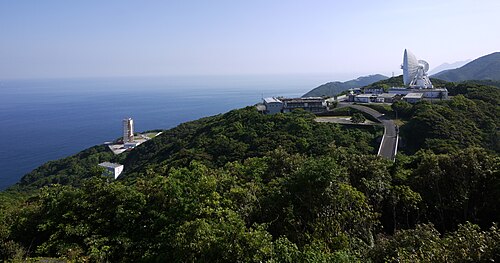
Uchinoura Space Center
Uchinoura Space Center (USC), located near Kimotsuki in Kagoshima Prefecture (31.
- Founded
- 1962
- Headquarters
- Kimotsuki, Japan
- Ownership
- Government
Quick Facts
About Uchinoura Space Center
Uchinoura Space Center (USC), located near Kimotsuki in Kagoshima Prefecture (31.25°N, 131.08°E) at the southern tip of Kyushu, is one of Japan's oldest and most historically significant launch facilities — the birthplace of Japan's space program and the site from which Japan launched its first satellite in 1970 to become the fourth nation in history to achieve independent orbital capability.
The facility was originally established in 1962 as the Kagoshima Space Center (KSC) by ISAS (Institute of Space and Astronautical Science), an independent academic organization separate from NASDA (the commercial/government satellite agency operating Tanegashima). This dual-track structure reflected a deliberate Japanese policy choice: ISAS focused on scientific missions driven by academic researchers using smaller, cheaper solid rockets, while NASDA handled commercial and government satellite programs with large liquid rockets. When NASDA, ISAS, and NAL merged to form JAXA in 2003, Kagoshima Space Center was renamed Uchinoura Space Center.
The landmark achievement at Uchinoura was the February 11, 1970 launch of Osumi — Japan's first satellite — aboard the Lambda-4S solid rocket: a 24 kg technology demonstration satellite that made Japan the world's fourth orbital-capable nation (after the USSR, USA, and France). This national milestone is commemorated annually as Japan's Space Day. The facility subsequently launched the M-series (Mu) rocket family — Japan's primary scientific satellite launcher through the 1970s-2000s — with the M-V (1997-2006) achieving 1.8 tonnes to LEO and lofting landmark missions including Hayabusa (2003, asteroid Itokawa sample return) and Nozomi (1998, Mars exploration).
Current operations center on the Epsilon solid rocket (300-700 kg LEO, launched since 2013), used for JAXA scientific missions including the ERG/Arase Van Allen belt probe, Hayabusa2 engineering validation instruments, and small satellite deployers. An improved Epsilon-S is under development following a 2022 launch anomaly. The center also operates sounding rocket ranges for suborbital science experiments — a function continuous since the 1950s under ISAS pioneer Hideo Itokawa, who began Japan's rocket program with pencil rockets and Kappa/Lambda sounding vehicles.
Signals
- Verification
- Verified 2026-09-04
Categories & Capabilities
Industry Categories
Location
Loading map...
Share
Suggest an Edit
Is this information outdated or incorrect? Help us improve this profile.
Submit CorrectionExplore More
Discover 1,000+ space companies worldwide
Similar Companies
Other companies in spaceports
Thumba Equatorial Rocket Launching Station
TERLS (Thumba Equatorial Rocket Launching Station) is India's first and most historically significant rocket launch site...
Portuguese Space Agency
Founded in 2019, the Portuguese Space Agency (PSA) serves as the national entity coordinating Portugal’s space activitie...
Wallops Flight Facility
NASA's Wallops Flight Facility, located on Wallops Island on Virginia's Eastern Shore, is one of the oldest rocket launc...
Esrange Space Center
Esrange Space Center, located near Kiruna in Swedish Lapland at approximately 68°N — 200 km north of the Arctic Circle —...
Tanegashima Space Center
Tanegashima Space Center (TNSC) is Japan's largest and primary orbital launch facility, operated by JAXA (Japan Aerospac...
Hokkaido Spaceport
Hokkaido Spaceport (HOSPO), located in Taiki Town (大樹町, Taiki-cho) in Hokkaido prefecture on Japan's northernmost main i...
Also in Japan
Other space companies based in Japan
Frequently asked about Uchinoura Space Center
Quick answers to the questions readers most often search for.
- When was Uchinoura Space Center founded?
- Uchinoura Space Center was founded in 1962 in Japan.
- Where is Uchinoura Space Center headquartered?
- Uchinoura Space Center is headquartered in Kimotsuki, Japan.
- What does Uchinoura Space Center do?
- Uchinoura Space Center (USC), located near Kimotsuki in Kagoshima Prefecture (31.25°N, 131.08°E) at the southern tip of Kyushu, is one of Japan's oldest and most historically significant launch facilities — the birthplace of Japan's space program and the site from which Japan launched its first satellite in 1970 to bec…
- What sector does Uchinoura Space Center operate in?
- Uchinoura Space Center works in spaceports and Research.
Data Accuracy Notice: Information about Uchinoura Space Center is compiled from publicly available sources including company websites, press releases, regulatory filings, and industry reports. Data is reviewed periodically but may not reflect the most recent developments.