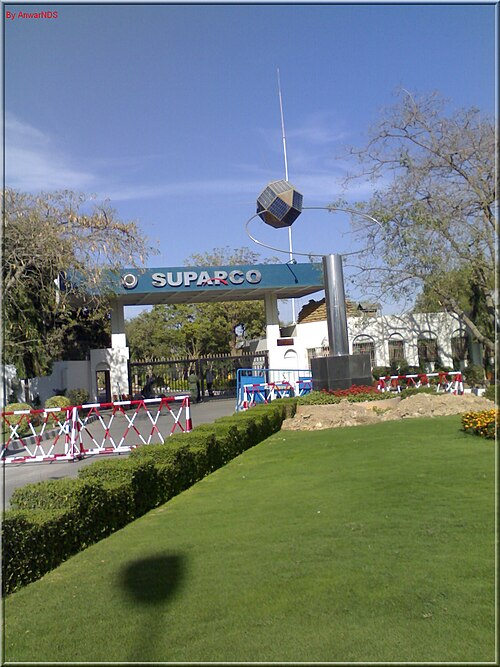
SUPARCO
The Space and Upper Atmosphere Research Commission (SUPARCO), headquartered in Karachi with administrative offices in Islamabad, is Pakistan's national space agency — the oldest space agency in Asia, established in 1961 (the same year as the first human spaceflight) — responsible for space research, satellite development and operations, remote sensing, and development of Pakistan's space capabilities. Founded initially under the Pakistan Atomic Energy Commission following discussions between Abdus Salam (Pakistan's Nobel laureate physicist) and NASA officials, SUPARCO launched Pakistan's first sounding rocket in 1962 from the Sonmiani Beach launch site — becoming one of the first developing nations to conduct space activities. The Sonmiani Space and Atmospheric Research Station (SUPARCO's launch facility in Balochistan) remains operational for sounding rocket research. SUPARCO's satellite program includes the Badr series: Badr-A (Pakistan's first satellite, launched 1990 aboard a Chinese Long March 2E), Badr-B (2001), and the PAKSAT series of geostationary communications satellites operated for the government and commercial telecommunications market. PAKSAT-1R, launched in 2011 and positioned at 38°E geostationary orbit, provides Ku-band television broadcasting, VSAT broadband, and government communications across South Asia and the Middle East. A follow-on PAKSAT-MM1 is planned. SUPARCO collaborates closely with China's National Space Administration (CNSA) — Pakistan was a beneficiary of Chinese space cooperation under the Pakistan-China space program framework, with Chinese expertise contributing to satellite bus development and ground station operations. Pakistan also operates an Earth observation program using remote sensing data from its satellites for flood monitoring, agricultural assessment, urban mapping, and border surveillance applications managed through SUPARCO's Regional Remote Sensing Applications Center. SUPARCO participates in UN COPUOS and the Asia-Pacific Space Cooperation Organization (APSCO).