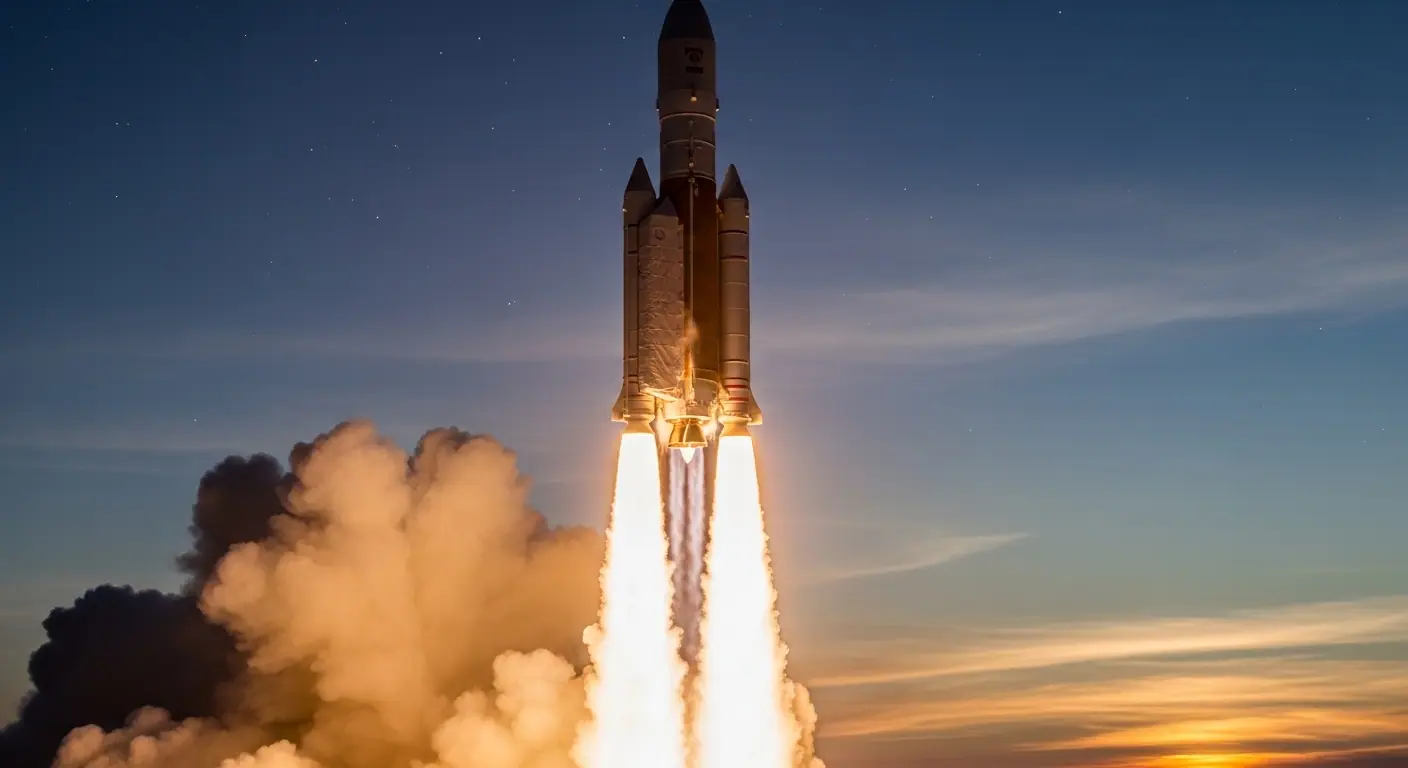
Europe's Space Program
The European Space Agency isn't one country's program -- it's 23 member states pooling money and industry into a single effort: the Ariane and Vega rockets, a permanent lab on the ISS, a spacecraft that landed on a comet, and a growing role in NASA's return to the Moon.
Program Timeline
From a 1975 merger of two smaller organizations to a comet landing, a permanent ISS lab, and a still-unresolved role in NASA's Artemis architecture.
ESA Formed from ELDO and ESRO
The European Space Agency was created on May 30, 1975, when the European Space Research Organisation (ESRO) and the European Launcher Development Organisation (ELDO) merged into a single body. Ten states -- Belgium, Denmark, France, West Germany, Italy, the Netherlands, Spain, Sweden, Switzerland, and the United Kingdom -- were founding members. ESA is not a national program: it is an intergovernmental agency now spanning 23 member states, headquartered in Paris with major sites in Germany, the Netherlands, and elsewhere across Europe.
Key Facts
- Merger of ESRO (research) and ELDO (launchers)
- 10 founding member states in 1975
- Grown to 23 member states; Latvia joined most recently, in 2024
Ariane 1 -- First Flight
Ariane 1 lifted off from the Guiana Space Centre in Kourou, French Guiana, giving Europe independent access to space for the first time. It was the start of a rocket family -- Ariane 1 through 4 -- that made Europe, via the newly formed commercial operator Arianespace (1980), the dominant force in commercial satellite launch through the 1980s and 1990s.
Key Facts
- Europe's first independent orbital launch vehicle
- Launched from the Guiana Space Centre, Kourou
- Led to Arianespace, the first commercial launch company
Ulf Merbold -- First ESA Astronaut in Space
West German physicist Ulf Merbold became the first ESA astronaut to fly to space, working aboard the European-built Spacelab module on Space Shuttle mission STS-9. It marked the start of a European astronaut corps that would go on to fly on the Space Shuttle, Mir, and the International Space Station, including Frank De Winne's 2009 tenure as the first European to command the ISS.
Key Facts
- First ESA astronaut to reach orbit
- Flew aboard the European-built Spacelab
- Preceded a European astronaut corps active on ISS ever since
Ariane 5 -- 27 Years as the Workhorse
Ariane 5's very first flight, in June 1996, ended in a spectacular failure 37 seconds after liftoff when a software data-conversion error sent the rocket off course, forcing its self-destruct. The redesigned vehicle went on to fly successfully for 27 years and 113 total missions, including launching the James Webb Space Telescope in December 2021 and JUICE in April 2023, before its final flight and retirement in July 2023 as Ariane 6 entered development.
Key Facts
- Famous Flight 501 failure in 1996 (software error)
- 113 total flights before retirement
- Launched JWST (2021) and JUICE (2023)
- Retired July 2023
Columbus Laboratory Launches to the ISS
The Columbus module -- ESA's largest single contribution to the ISS -- launched aboard Space Shuttle Atlantis on mission STS-122 and was attached to the station's Harmony node. Built in Turin by Thales Alenia Space with systems from Airbus Defence and Space in Bremen, Columbus gives European researchers a permanent laboratory in orbit for physics, biology, and materials science.
Key Facts
- ESA's largest single ISS contribution
- Built in Turin, Italy; systems from Bremen, Germany
- Still in active use for European science
Vega Enters Service
Vega gave Europe a dedicated small-satellite launcher, flying from the same Guiana Space Centre pad complex as Ariane. The original Vega retired in September 2024 after its final flight. Its upgraded successor, Vega-C, debuted in July 2022 but suffered a second-stage failure on only its second flight that December; after a nozzle redesign, Vega-C returned to flight in December 2024 and is now Europe's operational small-launch vehicle.
Key Facts
- Original Vega: 2012–2024, then retired
- Vega-C debut 2022, grounded after a Dec. 2022 failure
- Returned to flight December 2024 after motor redesign
Gaia -- Mapping a Billion Stars
Gaia measured the positions, distances, and motions of well over a billion stars with unprecedented precision, releasing successive data catalogs (DR1 through DR3) that reshaped astrometry. ESA passivated the spacecraft in March 2025 after more than 11 years of observations; processing of its final data release, expected around 2030, is still ongoing.
Key Facts
- Catalogued 1.8+ billion stars across multiple data releases
- Operated 11+ years at the Sun-Earth L2 point
- Decommissioned March 2025; data processing continues
Rosetta Orbits a Comet, Philae Lands
Launched in 2004, Rosetta became the first spacecraft to orbit a comet nucleus when it reached 67P/Churyumov-Gerasimenko in August 2014. Its Philae lander touched down that November in the first-ever controlled landing on a comet -- though its anchoring harpoons failed to fire and it bounced twice before settling in a shadowed spot, cutting its battery life short. Rosetta itself continued studying the comet for two more years before a final, deliberate descent onto its surface ended the mission on September 30, 2016.
Key Facts
- First spacecraft to orbit a comet nucleus
- Philae: first controlled landing on a comet (bounced, landed in shadow)
- Mission ended with a controlled impact in September 2016
ExoMars Loses Its Russian Launch Partner
ExoMars' Trace Gas Orbiter launched in 2016 and remains operational at Mars, relaying data and hunting trace atmospheric gases. Its companion, the Rosalind Franklin rover, was originally set to launch by 2020 on a Russian Proton rocket with a Roscosmos-built landing platform -- but ESA suspended that partnership on March 17, 2022 following Russia's invasion of Ukraine. After a funding and partnership reset with NASA in 2024, and with Thales Alenia Space and Airbus now building a European landing platform, the rover is currently targeting a late-2028 launch and a 2030 Mars landing.
Key Facts
- Trace Gas Orbiter operating at Mars since 2016
- Russian partnership suspended March 2022 after the Ukraine invasion
- Rosalind Franklin rover now targets late 2028 launch with NASA support
JUICE and Euclid Launch
ESA launched two flagship science missions months apart in 2023. JUICE (Jupiter Icy Moons Explorer) lifted off in April on one of the final Ariane 5 flights, beginning an eight-year cruise toward Ganymede, Callisto, and Europa, with Jupiter arrival expected in 2031. The Euclid space telescope followed in July aboard a SpaceX Falcon 9, and has been surveying roughly a third of the sky from L2 ever since to map dark matter and dark energy.
Key Facts
- JUICE: en route to three icy Jupiter moons, arrival 2031
- Euclid: operating at L2, mapping dark matter and dark energy
- Euclid flew on a Falcon 9 -- notable for an ESA flagship
Ariane 6 Enters Service
Ariane 6 was meant to debut in 2020; development delays pushed that back four years to its actual maiden flight on July 9, 2024, which reached orbit successfully but suffered a partial failure when its upper stage couldn't complete a planned deorbit burn. The vehicle -- built by ArianeGroup and operated by Arianespace in two configurations, the twin-booster A62 and quad-booster A64 -- has since restored independent European access to space after Ariane 5's retirement, flying nine missions with eight full successes through mid-2026.
Key Facts
- Debuted four years late: 2020 target vs. July 2024 actual
- Maiden flight reached orbit but had a partial upper-stage failure
- A62 (twin booster) and A64 (quad booster) configurations
- 9 flights, 8 full successes through mid-2026
NASA Pauses Gateway; I-Hab in Limbo
ESA's most direct hardware contribution to Artemis, the European Service Module, has powered every Orion flight to date and is already built for Artemis IV. But the lunar habitat module ESA was developing with JAXA for the Lunar Gateway, I-Hab, was thrown into question when NASA announced on March 24, 2026 that it would pause Gateway as designed and redirect funding toward a lunar surface base instead. ESA has said I-Hab will proceed through critical design review while a decision is made on repurposing it -- an unresolved question for Europe's biggest planned Artemis hardware contribution beyond Orion's service module.
Key Facts
- European Service Module has flown on every Orion mission so far
- NASA paused the Lunar Gateway program on March 24, 2026
- I-Hab habitat module status pending a repurposing decision
Rockets & Spacecraft
ESA's current launch fleet, its permanent ISS laboratory, and the hardware carrying Europe deeper into the solar system and toward the Moon.
Ariane 6
Europe's current heavy launcher, in two configurations: A62 (twin boosters, ~4.5t to GTO) and A64 (quad boosters, ~11.5t to GTO). Built by ArianeGroup, operated by Arianespace, launched from Kourou.
Vega-C
Europe's dedicated small-payload rocket. Grounded after a December 2022 second-stage failure, redesigned, and back in service since December 2024.
Columbus Module
ESA's largest single ISS contribution, launched in 2008 and still in active use for European microgravity research aboard the station.
European Service Module
Built by Airbus for NASA's Orion spacecraft, providing propulsion, power, water, and air on every crewed and uncrewed Artemis flight to date.
Rosalind Franklin Rover
ExoMars' astrobiology rover, redesigned after Russia's 2022 exit from the program. Now targets a late-2028 launch with NASA support and a 2030 Mars landing.
JUICE
Launched April 2023 on an Ariane 5, JUICE is on an eight-year cruise to study Ganymede, Callisto, and Europa, arriving at Jupiter in 2031.
See full specs on Ariane 6 or browse the full rocket comparison.
The Organizations Behind It
ESA sets policy and funds programs, but a "geographic return" principle spreads the actual hardware contracts across member-state industry.
Arianespace
Markets and operates Ariane 6 and Vega-C launches from the Guiana Space Centre
ArianeGroup
Prime contractor for the Ariane 6 rocket, formed by Airbus and Safran
Airbus Defence and Space
Builds the European Service Module for NASA's Orion, plus major satellite and science-mission hardware
Thales Alenia Space
Built the Columbus ISS module and works on the Rosalind Franklin landing platform
OHB SE
German prime contractor for ESA Earth observation and navigation satellites
Why Every European Rocket Launches from South America
Every Ariane and Vega flight since 1979 has lifted off from the Guiana Space Centre in Kourou, French Guiana -- an overseas territory of France on South America's northeast coast, not mainland Europe. Its location just 5 degrees north of the equator gives rockets a meaningful boost from Earth's rotational speed and opens a wide range of launch azimuths out over open ocean, making it one of the best-sited orbital launch complexes in the world for both equatorial and polar missions.
That single spaceport is also a reminder of what ESA is structurally: not a national space agency but a treaty organization of 23 member states that jointly fund mandatory science programs and separately opt into programs like human spaceflight or launchers. A "geographic return" rule ties industrial contracts to each country's financial contribution -- which spreads expertise across the continent, but also makes ESA's procurement slower and more political than a single national program like NASA, CNSA, or Roscosmos.
maximum rotational boost
and launch-azimuth flexibility
Related Content
Compare ESA's program with NASA's Moon efforts and the other national space programs building toward the same milestones.
NASA's Artemis Program
ESA's biggest current partnership -- the European Service Module flies on every Orion mission.
NASA's Apollo Program
The first Moon race, 1961-1972 -- more than a decade before ESA even flew its first Ariane rocket.
China's Space Program
A national, state-run program -- the sharpest contrast to ESA's 23-state coalition model.
Russia's Space Program
ESA's former ExoMars partner -- the collaboration that ended when Russia was cut from the Rosalind Franklin mission in 2022.
India's Space Program
ISRO, Chandrayaan, and Gaganyaan -- another national program racing to expand its footprint beyond Earth orbit.
Japan's Space Program
JAXA -- ESA's partner on the I-Hab lunar habitat module now caught up in Gateway's 2026 redesign.
Want the full deep dive?
Read our guide to European launch: Ariane 6's capabilities, Vega-C's return to flight, and the commercial startups challenging Arianespace at home.