ROCKET
TIMELINE
Every major launch vehicle from the V-2 to Starship — size comparisons, payload specs, and the history of humanity's reach into space.
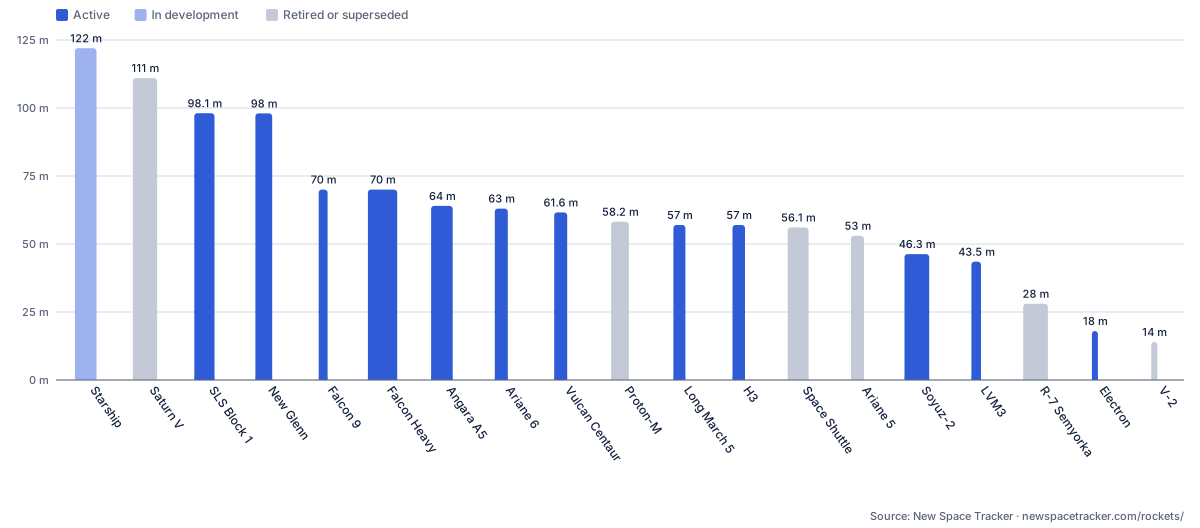
Size Comparison
All rockets shown to scale. Hover or tap a bar for full specs. Filter, then sort the table below.
Specifications — click column headers to sort
| Rocket | Height↓ | LEO Payload↕ | Thrust (kN)↕ | First Flight↕ |
|---|---|---|---|---|
| Starship↺ | 122m | 150t | 74,000 | 2023 |
| Saturn V | 111m | 130t | 34,020 | 1967 |
| SLS Block 1 | 98.1m | 95t | 39,144 | 2022 |
| New Glenn↺ | 98m | 45t | 17,000 | 2025 |
| Falcon 9↺ | 70m | 22.8t | 7,607 | 2010 |
| Falcon Heavy↺ | 70m | 63.8t | 22,819 | 2018 |
| Angara A5 | 64m | 24.5t | 9,600 | 2014 |
| Ariane 6 | 63m | 21.6t | 13,400 | 2024 |
| Vulcan Centaur | 61.6m | 27.2t | 16,500 | 2024 |
| Proton-M | 58.2m | 22.8t | 10,000 | 1965 |
| Long March 5 | 57m | 25t | 10,560 | 2016 |
| H3 | 57m | 16.5t | 9,000 | 2024 |
| Space Shuttle↺ | 56.1m | 24.4t | 30,160 | 1981 |
| Ariane 5 | 53m | 21t | 13,180 | 1996 |
| Soyuz-2 | 46.3m | 8.2t | 4,140 | 2004 |
| LVM3 (GSLV Mk III) | 43.5m | 10t | 10,100 | 2017 |
| R-7 Semyorka | 28m | 1.4t | 3,900 | 1957 |
| Electron | 18m | 0.3t | 192 | 2017 |
| V-2 | 14m | — | 249 | 1942 |
To-scale chart, static version
Every vehicle on one height scale, from the 19 in our dataset. This version needs no JavaScript and is the one you can embed on your own page.
Embed as a live chart
Updates when our dataset does. Follows the reader's light or dark setting.
Embed as an image
A plain SVG at /rockets/comparison.svg. Free to reuse with the link kept.
Active Fleet
Currently flying or in active development.
Starship
Largest and most powerful rocket ever built. Fully reusable — both Super Heavy booster and Ship return to launch site. Booster caught by tower arms. V3 targets 2026 debut.
SLS Block 1
NASA's deep space launch vehicle for the Artemis programme. Non-reusable. Launched Artemis I (2022) and Artemis II crew (April 2026).
Falcon Heavy
Three Falcon 9 cores strapped together. Most powerful operational rocket until Starship. Used for NASA Lunar Gateway and heavy DoD missions.
New Glenn
Blue Origin's heavy-lift orbital rocket. First reuse of its booster in April 2026 (NG-3). Competes with Falcon Heavy for heavy LEO/GTO missions.
Vulcan Centaur
ULA's next-generation launcher replacing Atlas V and Delta IV. ACES upper stage with 12-hour restart capability. Certified for national security missions.
Long March 5
China's most powerful operational rocket. Launched Tianwen-1 Mars mission, Chang'e 5 lunar sample return, and core modules of Tiangong space station.
Angara A5
Russia's new generation modular launch vehicle designed to replace Proton. Uses non-toxic propellants. Slow ramp-up to replace legacy Soviet-era hardware.
Falcon 9
The most launched orbital rocket in history. First to land and reflly an orbital booster. Over 300 flights; individual boosters have flown 20+ times.
Ariane 6
Europe's current flagship launcher. Two variants: A62 (twin boosters) and A64 (quad boosters). Restartable upper stage for multi-orbit missions.
H3
Japan's new main launch vehicle replacing H-IIA. LE-9 engines with no turbopumps. Aims to halve launch costs. Three variants from H3-22S to H3-24L.
LVM3 (GSLV Mk III)
India's heaviest rocket. Used for Chandrayaan-3 Moon landing and OneWeb constellation launches. Will carry Gaganyaan crew in late 2026.
Soyuz-2
Modern descendant of the R-7 that launched Sputnik. Most reliable rocket in history with 1,900+ flights across all variants.
Electron
3D-printed Rutherford engines, electric-pump-fed. The most-launched small orbital rocket. Rocket Lab recovers and refurbishes first stages. 80th flight in 2026.
History of Rocketry
Eight decades from the first ballistic missiles to the most powerful rocket ever built.
Pioneer Era
V-2
retiredFirst large guided ballistic missile and first man-made object to reach space. Designed by Wernher von Braun, ancestor of all modern rockets.
R-7 Semyorka
evolvedLaunched Sputnik 1 and Yuri Gagarin. The R-7 family is the most-launched rocket in history and still flies as the Soyuz-2 today.
Apollo Era
Saturn V
retiredThe most powerful rocket ever flown until Starship. Sent all 12 humans who walked on the Moon. 13 flights, 13 successes.
Cold War Era
Proton-M
retiringSoviet workhorse for heavy GEO missions. Over 400 flights since 1965. Being phased out in favour of Angara.
Soyuz-2
activeModern descendant of the R-7 that launched Sputnik. Most reliable rocket in history with 1,900+ flights across all variants.
Shuttle Era
Space Shuttle
retiredThe first partially reusable spacecraft. 135 missions over 30 years. Built the ISS. Lost Challenger (1986) and Columbia (2003).
Commercial Era
Ariane 5
retiredEurope's flagship launcher for 27 years. Launched JWST in December 2021 in its final year of commercial service. 113 flights.
New Space Era
Falcon 9
activeThe most launched orbital rocket in history. First to land and reflly an orbital booster. Over 300 flights; individual boosters have flown 20+ times.
Falcon Heavy
activeThree Falcon 9 cores strapped together. Most powerful operational rocket until Starship. Used for NASA Lunar Gateway and heavy DoD missions.
Starship
developmentLargest and most powerful rocket ever built. Fully reusable — both Super Heavy booster and Ship return to launch site. Booster caught by tower arms. V3 targets 2026 debut.
SLS Block 1
activeNASA's deep space launch vehicle for the Artemis programme. Non-reusable. Launched Artemis I (2022) and Artemis II crew (April 2026).
New Glenn
activeBlue Origin's heavy-lift orbital rocket. First reuse of its booster in April 2026 (NG-3). Competes with Falcon Heavy for heavy LEO/GTO missions.
Ariane 6
activeEurope's current flagship launcher. Two variants: A62 (twin boosters) and A64 (quad boosters). Restartable upper stage for multi-orbit missions.
Vulcan Centaur
activeULA's next-generation launcher replacing Atlas V and Delta IV. ACES upper stage with 12-hour restart capability. Certified for national security missions.
Electron
active3D-printed Rutherford engines, electric-pump-fed. The most-launched small orbital rocket. Rocket Lab recovers and refurbishes first stages. 80th flight in 2026.
Long March 5
activeChina's most powerful operational rocket. Launched Tianwen-1 Mars mission, Chang'e 5 lunar sample return, and core modules of Tiangong space station.
H3
activeJapan's new main launch vehicle replacing H-IIA. LE-9 engines with no turbopumps. Aims to halve launch costs. Three variants from H3-22S to H3-24L.
LVM3 (GSLV Mk III)
activeIndia's heaviest rocket. Used for Chandrayaan-3 Moon landing and OneWeb constellation launches. Will carry Gaganyaan crew in late 2026.
Angara A5
activeRussia's new generation modular launch vehicle designed to replace Proton. Uses non-toxic propellants. Slow ramp-up to replace legacy Soviet-era hardware.
Full Specifications
All rockets sorted by payload to LEO.
| Rocket | Operator | Height | LEO (t) | GTO (t) | Thrust (kN) | Reusable | First Flight | Status |
|---|---|---|---|---|---|---|---|---|
Starship | SpaceX | 122m | 150 | — | 74,000 | ✓ | 2023 | development |
Saturn V | NASA | 111m | 130 | 48.6 | 34,020 | — | 1967 | retired |
SLS Block 1 | NASA/Boeing | 98.1m | 95 | 27 | 39,144 | — | 2022 | active |
Falcon Heavy | SpaceX | 70m | 63.8 | 26.7 | 22,819 | ✓ | 2018 | active |
New Glenn | Blue Origin | 98m | 45 | 13 | 17,000 | ✓ | 2025 | active |
Vulcan Centaur | ULA | 61.6m | 27.2 | 18.1 | 16,500 | — | 2024 | active |
Long March 5 | CASC | 57m | 25 | 14 | 10,560 | — | 2016 | active |
Angara A5 | Roscosmos | 64m | 24.5 | 7.5 | 9,600 | — | 2014 | active |
Space Shuttle | NASA | 56.1m | 24.4 | 3.8 | 30,160 | ✓ | 1981 | retired |
Proton-M | Roscosmos/ILS | 58.2m | 22.8 | 6.3 | 10,000 | — | 1965 | retiring |
Falcon 9 | SpaceX | 70m | 22.8 | 8.3 | 7,607 | ✓ | 2010 | active |
Ariane 6 | Arianespace | 63m | 21.6 | 11.5 | 13,400 | — | 2024 | active |
Ariane 5 | Arianespace | 53m | 21 | 10.86 | 13,180 | — | 1996 | retired |
H3 | JAXA/MHI | 57m | 16.5 | 6.5 | 9,000 | — | 2024 | active |
LVM3 (GSLV Mk III) | ISRO | 43.5m | 10 | 4 | 10,100 | — | 2017 | active |
Soyuz-2 | Roscosmos | 46.3m | 8.2 | 2.8 | 4,140 | — | 2004 | active |
R-7 Semyorka | Soviet Space Program | 28m | 1.4 | — | 3,900 | — | 1957 | evolved |
Electron | Rocket Lab | 18m | 0.3 | — | 192 | — | 2017 | active |
V-2 | Third Reich | 14m | — | — | 249 | — | 1942 | retired |