Category

Nuclear Companies

12 organizations3 countries2 listed

12 organizations working in nuclear across the global space industry.

Names to know in nuclear

Rank all by market value →
Nuclear Verified BWXT

BWX Technologies Space

Lynchburg, United States commercial

BWX Technologies (NYSE: BWXT) stands at the forefront of nuclear technology development for space exploration, playing a pivotal role in NASA's ambitious plans to revolutionize deep space propulsion. Headquartered in Lynchburg, Virginia, the company brings decades of expertise in nuclear reactor design and manufacturing to the emerging field of space nuclear propulsion. BWXT was to build the reactor for DARPA's Demonstration Rocket for Agile Cislunar Operations (DRACO), a nuclear thermal propulsion demonstrator with Lockheed Martin, but the flight was put on hold in January 2025, NASA zeroed its share of the funding that May, and DARPA confirmed the programme had ended in June 2025. Under a contract worth approximately $200 million over three years, BWXT is responsible for designing the nuclear reactor, manufacturing the hardware and high-assay low-enriched uranium (HALEU) fuel, and delivering the complete fueled reactor subsystem. Nuclear thermal propulsion offers thrust-to-weight ratios 10,000 times greater than electric propulsion and specific impulse two to five times greater than chemical rockets. In March 2025, BWXT opened its Innovation Campus, a 170,000 square-foot facility dedicated to advancing nuclear technologies for land, sea, and space applications. This campus houses the Advanced Technologies business unit and over 350 team members working on cutting-edge nuclear systems for NASA, the Department of Energy, Department of Defense, and commercial applications. The company has been involved with NASA's Nuclear Thermal Propulsion design since 2017, establishing itself as a leading U.S. entity capable of producing space-grade nuclear reactors.


Lynchburg, United States · Est. 1867 $13.8B
Nuclear Verified TDY

Teledyne Energy Systems

Hunt Valley, United States commercial

Teledyne Energy Systems, headquartered in Hunt Valley, Maryland and operating as a division of Teledyne Technologies (NYSE: TDY), is the United States' leading manufacturer of radioisotope thermoelectric generators (RTGs) and hydrogen-oxygen fuel cells for deep space, planetary science, and lunar surface spacecraft — providing the nuclear and electrochemical power systems that enable missions to destinations too distant from the Sun for solar panels to generate sufficient power. Teledyne Energy Systems has manufactured RTGs for NASA since the Apollo lunar surface science experiments through a decades-long partnership with the U.S. Department of Energy. RTGs convert heat from the natural radioactive decay of plutonium-238 (Pu-238) — produced in the DOE's Oak Ridge National Laboratory reactors — into electricity via thermoelectric couples (silicon-germanium alloys and PbTe thermoelectrics), with no moving parts, no fuel consumption, and multi-decade operating lifetimes. The Multi-Mission Radioisotope Thermoelectric Generator (MMRTG) developed by Teledyne Energy Systems (with prime contractor responsibilities shared with Aerojet Rocketdyne) powers NASA's Curiosity Mars rover and Perseverance Mars rover — generating approximately 110 watts of electrical power at Beginning of Mission (BOM) from a General Purpose Heat Source (GPHS) module stack containing 4.8 kg of Pu-238 dioxide pellets. The MMRTG also provides continuous waste heat that warms rover electronics through the extreme cold of Martian nights (below -73°C). Beyond RTGs, Teledyne Energy Systems manufactures closed-cycle hydrogen-oxygen fuel cells and electrolyzers for spacecraft water electrolysis and power storage, custom lithium-ion battery systems for satellite and spacecraft applications, and electrochemical systems for life support. The company's fuel cell heritage includes systems for ISS. Teledyne Energy Systems competes with its own parent company's other divisions and with Battery Technology Solutions and EaglePicher Technologies for specialized space power applications.

Hunt Valley, United States · Est. 1968 $28.0B
Satellite Manufacturing

General Atomics EMS

San Diego, United States commercial

General Atomics Electromagnetic Systems (GA-EMS) is a diversified technology company applying decades of research and development expertise to deliver advanced systems for defense, security, and commercial applications. Founded in 1955 and based in San Diego, California, GA-EMS operates across a broad spectrum of capabilities, including satellite manufacturing as part of its Space Systems portfolio. Beyond space, the company focuses on areas such as aircraft launch and recovery systems, power and energy solutions – notably batteries and advanced capacitor technology – and missile defense. A significant portion of GA-EMS’ work centers around specialized technologies. This includes nuclear technologies and materials, precision manufacturing, and detection & imaging products. They also offer solutions for environmentally critical areas like demilitarization and hazardous waste destruction, utilizing electrostatic separation technologies through their Gulftronic product line. The company’s capabilities extend to the design and production of motors, generators, and drives, alongside radiation monitoring systems. While specific mission details and customer lists are not publicly emphasized, GA-EMS positions itself as a provider of multi-mission systems supporting national security interests and critical commercial enterprises globally. Their broad technological base suggests a role as a key supplier of specialized components and integrated systems to both government and private sector clients. GA-EMS differentiates itself through its long history of innovation and its ability to integrate diverse technologies – from nuclear materials to electromagnetic systems – into complex solutions. This allows them to address challenging requirements in demanding environments, offering a unique value proposition for customers seeking highly specialized and reliable technologies.

San Diego, United States · Est. 1955
Satellite Manufacturing Verified

INVAP

San Carlos de Bariloche, Argentina commercial

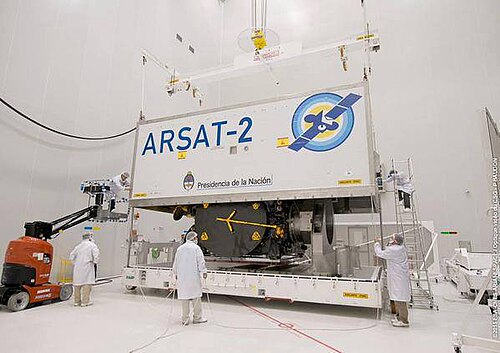
INVAP (Investigación Aplicada) is an Argentine state-owned high-technology company headquartered in San Carlos de Bariloche, Patagonia, and owned by the Río Negro provincial government — one of Latin America's most capable aerospace and nuclear technology organizations, with a satellite manufacturing program recognized internationally for delivering complex space systems to both domestic and export customers. Founded in 1976 as a spin-off of the Argentine Atomic Energy Commission (CNEA), INVAP's original mandate was to design and manufacture research nuclear reactors. The company has since exported research reactors to Algeria, Egypt, Australia, Peru, and Saudi Arabia — a unique commercial achievement for a developing-nation nuclear technology exporter. This engineering culture of complex system integration transitioned naturally into satellite development as Argentina's space program expanded under CONAE (Comisión Nacional de Actividades Espaciales). In the satellite domain, INVAP has manufactured SAOCOM 1A and 1B — twin L-band synthetic aperture radar (SAR) Earth observation satellites launched in 2018 and 2020 aboard SpaceX Falcon 9 rockets. SAOCOM is operated by CONAE and forms part of a bilateral Italian-Argentine SIASGE constellation with the Italian COSMO-SkyMed radar satellites, providing complementary L-band and X-band SAR coverage for flood mapping, soil moisture measurement, agricultural monitoring, and emergency response. L-band SAR penetrates cloud cover and vegetation canopy, making SAOCOM particularly valuable for tropical and polar-region land monitoring. INVAP also manufactured the SAC-D/Aquarius satellite (launched 2011, a joint NASA-CONAE mission) that carried NASA's Aquarius instrument for global ocean salinity mapping alongside CONAE instruments for thermal radiation and microwave imaging. Additionally, INVAP built the SAC-A and SAC-C Earth observation satellites, establishing Argentina's continuity as one of the few developing nations with indigenous satellite manufacturing capability spanning optical, radar, and scientific payload platforms.

San Carlos de Bariloche, Argentina · Est. 1976
Power Systems

Space Nuclear Power Corporation

Los Alamos, United States commercial

Space Nuclear Power Corporation (SpaceNukes) is a US-based company specializing in the design and fabrication of fission reactor power systems for space applications, with a focus on enabling sustained operations on the Moon, Mars, and beyond. Founded in 2001, the company distinguishes itself by concentrating on practical, flight-ready reactor technology, contrasting with purely theoretical designs. SpaceNukes is currently focused on delivering high-confidence, reliable power solutions for near-term lunar and Martian surface missions. A key technological achievement is the Kilopower Reactor Using Stirling Technology (KRUSTY), the only new reactor concept designed, developed, and tested in the United States in the last 50 years. This testing, conducted in 2018, demonstrates the company’s capabilities in reactor development and validation. SpaceNukes emphasizes its ability to deliver reactors capable of flight within a three-year timeframe, positioning it as a leader in rapidly deployable space nuclear power. While specific customers are not publicly detailed, the company’s technology is clearly geared towards supporting NASA’s ambitions for long-duration lunar and Martian exploration and potential commercial ventures requiring substantial and reliable power sources in space. SpaceNukes’ unique value proposition lies in its commitment to “real” reactor development – moving beyond conceptual designs to deliver tested, flight-ready systems, addressing a critical need for sustained power in deep space environments.

Los Alamos, United States · Est. 2001
Propulsion Verified

Ultra Safe Nuclear

Seattle, United States commercial

Ultra Safe Nuclear (USNC), founded in 2011 and based in Seattle, Washington, is a company focused on the development of nuclear thermal propulsion (NTP) systems. The company’s core business centers around applying nuclear technology to space exploration, specifically aiming to significantly enhance spacecraft propulsion capabilities. While detailed product information is currently limited, USNC’s focus on NTP indicates a commitment to developing systems that offer higher thrust and efficiency compared to conventional chemical rockets. USNC’s key technology lies in the application of nuclear fission to heat a propellant – likely hydrogen – to extremely high temperatures, creating exhaust velocities far exceeding those achievable with traditional methods. This approach promises reduced travel times for deep-space missions and increased payload capacity. The company is positioned within a growing, though still nascent, sector of the space industry focused on advanced propulsion technologies. Currently, publicly available information regarding specific missions, achievements, or customer contracts is limited. However, the pursuit of NTP technology suggests USNC is targeting long-duration space travel, potentially serving government space agencies or, in the future, private companies planning ambitious interplanetary missions. USNC’s unique value proposition rests on its specialization in nuclear technology for space applications. As interest in lunar and Martian exploration increases, and the demand for faster, more efficient space travel grows, USNC is strategically positioned to become a key player in enabling these future endeavors, should their technology prove viable and scalable.

Seattle, United States · Est. 2011
Power Systems In development

Antares Industries

Torrance, United States commercial

Antares Industries, founded in 2023 and based in Torrance, California, is a developing space technology company focused on advanced power systems. The company’s core business centers around the development of kilowatt-scale nuclear fission microreactors designed for space applications. This technology aims to provide a sustained, reliable power source independent of traditional methods like solar or batteries, particularly for long-duration missions and remote operations. Antares Industries emphasizes a key differentiator in its design: a three-year operational lifespan without requiring resupply or specialized maintenance. This is achieved through fully automated controls, integrated power management, and distribution systems, reducing the logistical complexities and costs associated with maintaining power infrastructure in space. The company’s focus on automation suggests a capability in robust control systems and potentially, advanced materials science to ensure long-term reliability in the harsh space environment. Currently, publicly available information regarding specific missions, deployments, or customer contracts is limited. However, the development of a sustained, independent power source positions Antares Industries to serve a growing need within the space industry. The company’s unique value proposition lies in providing a long-life, low-maintenance power solution, potentially enabling more ambitious and sustained space exploration, lunar surface operations, and deep-space missions where consistent, reliable power is paramount. This approach could reduce reliance on complex logistical support and specialized personnel, offering a cost-effective and scalable power solution for future space endeavors.

Torrance, United States · Est. 2023
Nuclear Acquired

Atomos Nuclear and Space

London, United States commercial

Atomos Nuclear and Space, founded in 2021 and based in London, United Kingdom, is a space technology company focused on the development of nuclear-powered spacecraft systems. The company’s core business centers around enabling advanced space operations, specifically targeting cislunar space – the region around the Earth and Moon – and deep space exploration. Atomos is currently concentrating its efforts on nuclear electric propulsion (NEP) systems, indicating a focus on providing efficient and sustained thrust for long-duration missions. While specific technological details are currently limited due to a lack of publicly available information, the company’s stated focus on NEP suggests expertise in areas such as small modular reactors, radiation shielding, power conversion systems, and potentially advanced materials science. Nuclear electric propulsion offers significantly higher specific impulse compared to conventional chemical rockets, allowing for greater payload capacity and reduced transit times for missions requiring substantial delta-v. Currently, publicly available information does not detail specific missions, achievements, or customer contracts for Atomos Nuclear and Space. However, the company’s chosen focus area positions it within a growing segment of the space industry. There is increasing interest in nuclear propulsion from both government agencies and private companies seeking to expand capabilities for lunar infrastructure, asteroid redirection, and ultimately, crewed missions to Mars. Atomos Nuclear and Space appears to be differentiating itself by concentrating specifically on the development of the enabling technology – the nuclear electric propulsion systems – rather than end-to-end mission services. This specialization allows them to potentially serve as a key supplier to larger space companies and government organizations pursuing ambitious deep space objectives, filling a critical need for advanced and sustainable propulsion solutions.

London, United States · Est. 2018
Propulsion In development

Avalanche Energy

Seattle, United States commercial

Avalanche Energy, founded in 2018 and based in Seattle, Washington, is a space-focused company developing compact fusion devices. The company concentrates on building modular fusion systems designed to provide both propulsion and power for satellites and spacecraft. This positions Avalanche Energy within the emerging field of advanced space power and propulsion technologies. Avalanche Energy’s core business revolves around the development of these compact fusion machines, suggesting a focus on miniaturization and scalability of fusion technology – a traditionally large and complex undertaking. While specific technological details are limited in publicly available information, the emphasis on “modular” systems implies a design philosophy centered around building power and propulsion solutions from interconnected, standardized components. Currently, Avalanche Energy’s website does not detail specific missions, customers, or partnerships. However, the company’s stated vision of providing “power without limits” for space applications indicates an ambition to address the growing power demands of increasingly sophisticated satellite constellations and deep-space exploration missions. Avalanche Energy aims to differentiate itself by focusing on compact fusion – a potentially disruptive technology that, if successful, could offer significantly higher power density and efficiency compared to traditional chemical or solar-based systems. This positions the company to potentially serve a future market demanding high-performance power and propulsion for advanced space applications.

Seattle, United States · Est. 2018

Explore all 12 nuclear organisations

Filter by country, type or status, sort by market value or founding year. The view is saved in the address bar.

Skip to results

Loading companies…

Loading companies…