Category

Radar Companies

3 organizations3 countries

3 organizations working in radar across the global space industry.

Names to know in radar

Rank all by market value →
Satellite Manufacturing Verified

INVAP

San Carlos de Bariloche, Argentina commercial

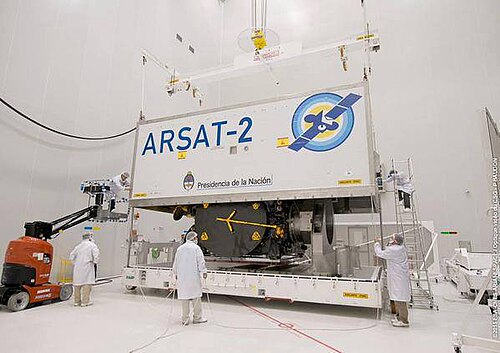
INVAP (Investigación Aplicada) is an Argentine state-owned high-technology company headquartered in San Carlos de Bariloche, Patagonia, and owned by the Río Negro provincial government — one of Latin America's most capable aerospace and nuclear technology organizations, with a satellite manufacturing program recognized internationally for delivering complex space systems to both domestic and export customers. Founded in 1976 as a spin-off of the Argentine Atomic Energy Commission (CNEA), INVAP's original mandate was to design and manufacture research nuclear reactors. The company has since exported research reactors to Algeria, Egypt, Australia, Peru, and Saudi Arabia — a unique commercial achievement for a developing-nation nuclear technology exporter. This engineering culture of complex system integration transitioned naturally into satellite development as Argentina's space program expanded under CONAE (Comisión Nacional de Actividades Espaciales). In the satellite domain, INVAP has manufactured SAOCOM 1A and 1B — twin L-band synthetic aperture radar (SAR) Earth observation satellites launched in 2018 and 2020 aboard SpaceX Falcon 9 rockets. SAOCOM is operated by CONAE and forms part of a bilateral Italian-Argentine SIASGE constellation with the Italian COSMO-SkyMed radar satellites, providing complementary L-band and X-band SAR coverage for flood mapping, soil moisture measurement, agricultural monitoring, and emergency response. L-band SAR penetrates cloud cover and vegetation canopy, making SAOCOM particularly valuable for tropical and polar-region land monitoring. INVAP also manufactured the SAC-D/Aquarius satellite (launched 2011, a joint NASA-CONAE mission) that carried NASA's Aquarius instrument for global ocean salinity mapping alongside CONAE instruments for thermal radiation and microwave imaging. Additionally, INVAP built the SAC-A and SAC-C Earth observation satellites, establishing Argentina's continuity as one of the few developing nations with indigenous satellite manufacturing capability spanning optical, radar, and scientific payload platforms.

San Carlos de Bariloche, Argentina · Est. 1976
Weather

Climavision

Louisville, United States commercial

Climavision is a Louisville, Kentucky-based weather technology company founded in 2018 that operates a private network of high-resolution dual-polarization Doppler radar installations to fill gaps in NOAA's National Weather Service radar coverage — particularly in complex terrain and coastal areas where the federal WSR-88D NEXRAD network has significant blind spots below ~3,000 feet altitude. The company integrates its ground radar data with satellite weather data and numerical weather prediction models to provide hyperlocal forecast intelligence. Primary customers include the insurance industry (catastrophe risk assessment), agriculture (crop protection), aviation, and energy utilities. Climavision raised $150M+ and is deploying a radar network complementary to, not competitive with, the government weather infrastructure.

Louisville, United States · Est. 2018
Space Situational Awareness In development

iSEE Space

Arlington, Austria commercial

iSEE Space is an Austria- and US-based Space Situational Awareness (SSA) startup founded in 2023 developing an in-orbit radar fence constellation — a network of satellites in LEO carrying radar transmitters and receivers that collectively form a persistent electromagnetic detection barrier capable of detecting, tracking, and characterizing other resident space objects (satellites, debris, and unknown threats) across orbital regimes. The radar fence concept builds on the successful ground-based Space Fence (U.S. Space Force S-Band radar on Kwajalein Atoll) which detects objects crossing its radar beam. An orbital radar fence flips this geometry: instead of a fixed ground site detecting objects crossing overhead, the orbital constellation's radar beams form a sensor web in space itself — eliminating atmospheric propagation losses that degrade ground radar sensitivity at low elevation angles, providing persistent (not pass-dependent) coverage of orbital regimes, and enabling tracking of objects at all altitudes rather than only those passing above a ground site's horizon. Radar from orbit can also detect smaller cross-section objects (estimated <1 cm capability long-term) compared to ground radars limited by transmission path length. AI-powered analytics are central to iSEE Space's value proposition: automated conjunction assessment generating probability of collision warnings, anomalous maneuver detection (identifying non-cooperative satellites performing station changes), debris-generating event attribution, and early warning for anti-satellite (ASAT) weapon use or intentional proximity operations — the Space Domain Awareness (SDA) layer valued by both commercial operators and defense customers. Founded in 2023, iSEE Space is pre-revenue and pre-launch — at the concept demonstration and seed funding phase. Its dual Austria/US presence positions it to pursue ESA Space Safety Programme funding (Austria contributes to ESA) alongside U.S. Space Force commercial SSA contract vehicles (Commercial SSA Data Services, TraCSS). Competitors include LeoLabs (ground radar), ExoAnalytic Solutions (optical), Slingshot Aerospace (data analytics), and the proposed Northstar Earth and Space orbital SSA constellation (SAR + optical). iSEE's orbital radar fence concept would be a new modality if executed.

Arlington, Austria · Est. 2023

Explore all 3 radar organisations

Filter by country, type or status, sort by market value or founding year. The view is saved in the address bar.

Skip to results

Loading companies…

Loading companies…