🇦🇷 Latin America · Country hub

Space industry in Argentina

8 organisations2 agenciessince 1976 tracked history

8 agencies, companies and research groups headquartered in Argentina, from launch and satellites to data and defence.

Jump in

Each card opens a filtered view below

Quick facts

National space body
CONAE · est. 1991
Tracked organisations
8
Industry active since
1976 · median founding 2016
Largest hub
Buenos Aires (7)
Leading sector
Satellite Communications (3)
Satellite Operators Verified

ARSAT

Buenos Aires, Argentina government

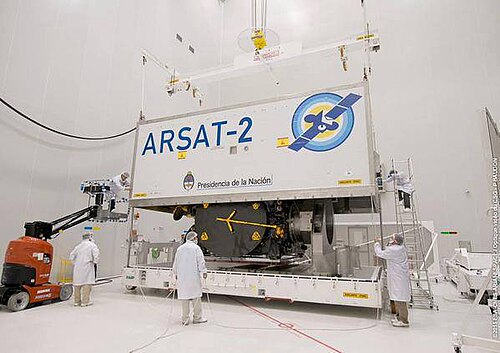
ARSAT is an Argentine state-owned telecommunications company founded in 2006, focused on providing wholesale telecommunications solutions across Argentina. The company operates as a key infrastructure provider, delivering connectivity services including satellite and terrestrial networks, cloud solutions, datacenter services, and cybersecurity offerings. ARSAT’s core business centers around building and operating national infrastructure to expand connectivity throughout the country, with a stated emphasis on federal coverage. A defining characteristic of ARSAT is its ownership and operation of geostationary (GEO) satellites, specifically ARSAT-1 and ARSAT-2, which were constructed by INVAP, an Argentine technology company. These satellites are integral to ARSAT’s service offerings, enabling digital television broadcasting and internet connectivity services. ARSAT positions itself as a wholesale provider, suggesting its primary customers are other telecommunications companies and service providers who then deliver services to end-users. The company’s focus on national infrastructure and broad service offerings indicates a strategic role in expanding digital access and bolstering telecommunications capabilities within Argentina.


Buenos Aires, Argentina · Est. 2006
Space Agencies Verified

CONAE

Buenos Aires, Argentina government

The National Commission for Space Activities (CONAE, Comisión Nacional de Actividades Espaciales) is Argentina's government space agency, established in 1991 and headquartered in Buenos Aires — one of Latin America's most technically capable space agencies, known internationally for its SAR Earth observation satellite constellation, bilateral cooperation agreements with NASA and ESA, and its role as an anchor for Argentina's aerospace industrial base. CONAE's flagship achievement is the SAOCOM (Satélite Argentino de Observación Con Microondas) constellation — two L-band synthetic aperture radar (SAR) satellites that together provide continuous SAR imaging of South America and other regions. SAOCOM 1A launched in 2018 aboard a SpaceX Falcon 9 from Vandenberg in the first West Coast Falcon 9 launch, and SAOCOM 1B followed in 2020. L-band SAR (23 cm wavelength) penetrates vegetation canopy and can image through cloud cover — making SAOCOM ideal for agricultural monitoring (soil moisture mapping, crop identification, flood extent mapping beneath forest canopy), emergency management, and subsidence monitoring of infrastructure and cities. SAOCOM is part of a bilateral Argentina-Italy cooperation program: Italy's ASI (Agenzia Spaziale Italiana) provides COSMO-SkyMed X-band SAR data to CONAE in exchange for SAOCOM L-band data, creating a complementary multi-frequency SAR monitoring capability called SIASGE (Sistema Italo-Argentino de Satélites para la Gestión de Emergencias) that has been used extensively for disaster response in South America. Earlier CONAE programs include the SAC (Satélite de Aplicaciones Científicas) series: SAC-A (1998), SAC-B (1996, technology demonstration), and SAC-C (2000, Earth observation with NASA data-sharing partnership). CONAE's Córdoba ground station receives satellite data and the agency operates the INVAP space technology company (which builds CONAE's satellites) through the provincial government of Río Negro. CONAE represents Argentina as a respected peer in international space cooperation, having contributed instruments to ESA's Earth observation missions and maintaining bilateral agreements with NASA, ESA, DLR, and China's CNSA. Argentina's status as one of only a handful of developing nations with indigenous SAR satellite design and manufacturing capability distinguishes CONAE globally.

Buenos Aires, Argentina · Est. 1991
Launch Services In development

LIA Aerospace

Buenos Aires, Argentina commercial

LIA Aerospace (Laboratorio de Investigación Aeroespacial), a Buenos Aires-based Argentine aerospace startup, is developing sustainable propulsion systems and small launch vehicles for orbital access from South America — gaining recognition as the creator of Zonda 1.0, Argentina's first biofuel rocket manufactured by a private company, demonstrating technical capability to develop alternative propellant rocket technology in South America. Zonda 1.0 is a sounding/suborbital rocket using biofuel propellants — biological or synthetic fuel alternatives to conventional petroleum-derived kerosene or UDMH that reduce petroleum dependency and, in some formulations, offer reduced toxicity compared to hypergolic propellants. The biofuel focus positions LIA within the growing segment of aerospace companies pursuing propellant sustainability to address environmental concerns about rocket exhaust atmospheric effects and align with broader decarbonization narratives in the launch industry. LIA Aerospace's longer-term ambition is orbital launch capability from Argentine soil — a goal that would serve South America's growing satellite operator community and potentially provide launch competition in a region currently dependent on foreign rockets. Argentina's INVAP national technology company has aerospace design expertise, and CONAE (Argentina's space agency) has operated satellite programs providing a domestic customer base and regulatory framework for commercial launch development. Argentina's geographic position at southern latitudes offers the same polar and sun-synchronous orbit access advantages as other Southern Hemisphere launch sites, with Pacific Ocean downrange corridors from western Argentina or Atlantic access from eastern coastal sites. LIA Aerospace competes in the Argentine commercial launch space with TLON Space (Aventura I), while internationally facing competition from RocketLab (New Zealand), ISRO PSLV (India), and Chinese commercial small rockets for the South American satellite launch market.

Buenos Aires, Argentina · Est. 2019
Launch Services In development

TLON Space

Buenos Aires, Argentina commercial

TLON Space is an Argentine aerospace startup developing Aventura I — a small, environmentally sustainable orbital launch vehicle designed to provide affordable nanosatellite launch access from South America. The 10-meter tall rocket targets approximately 25 kg payload capacity to low Earth orbit, positioning it in the ultra-light launch segment serving 1U-6U CubeSats and small nanosatellite constellations. TLON's sustainability emphasis distinguishes its design philosophy: the company is focused on propellant choices and operational practices that minimize environmental impact relative to conventional small rockets. This includes considering bio-derived or lower-toxicity propellant alternatives and minimizing launch infrastructure footprint — important considerations as the launch industry faces growing scrutiny over atmospheric deposition of rocket exhaust products and black carbon soot in the mesosphere from increasing launch cadence. Argentina is a credible launch nation: CONAE (the Argentine space agency) has operated the SAC series of Earth observation satellites and the INVAP technology company has built reactors and the SAC satellites, establishing a domestic aerospace manufacturing ecosystem. TLON seeks to leverage this foundation to build commercial launch capability that would give South American satellite operators a regional sovereign launch option, reducing dependence on US, European, and Asian launch providers. The ultra-light launch market (sub-100 kg payloads) has attracted numerous startups globally given the growth of CubeSat and nanosatellite deployments, though the market has proven difficult to scale economically against SpaceX Transporter rideshare pricing. TLON competes conceptually with Electron (RocketLab), PSLV-CA (ISRO), and other small launch vehicles, differentiating through South American location, sustainability positioning, and regional market relationships within Latin America's growing space sector.

Buenos Aires, Argentina · Est. 2021
Satellite Communications

Innova Space

Buenos Aires, Argentina commercial

Innova Space is an Argentine commercial space company headquartered in Buenos Aires, developing the Libertadores de América satellite IoT constellation — a planned network of approximately 90 small satellites specifically designed to serve Latin America's agriculture, mining, oil and gas, and logistics sectors with low-power, low-cost satellite connectivity for remote asset monitoring and data collection. Latin America's vast agricultural interior — the Argentine Pampas, Brazilian cerrado, and Amazon basin — encompasses hundreds of millions of hectares of farmland, mining operations, pipeline infrastructure, and shipping routes lying entirely beyond cellular coverage and beyond the economic reach of traditional VSAT satellite broadband. Innova Space targets the mass-market IoT data communication need: soil moisture sensors, grain silo temperature monitors, livestock trackers, pipeline pressure sensors, and shipping container location services that require sending small data packets infrequently and cheaply rather than continuous broadband streaming. The Libertadores de América constellation uses store-and-forward satellite communications, collecting sensor data during each orbital pass over coverage regions and relaying it to ground stations for delivery to customer cloud platforms. The system architecture is designed for integration with LoRa-compatible ground terminals, compatible with existing IoT hardware already deployed across South American agricultural and industrial facilities. Innova Space benefits from Argentina's established aerospace engineering ecosystem anchored by CONAE (Argentina's space agency) and INVAP (state-owned aerospace and nuclear manufacturer), and competes with Astrocast, Lacuna Space, and Satellogic within the Latin American space data market.

Buenos Aires, Argentina · Est. 2016
Satellite Manufacturing Verified

INVAP

San Carlos de Bariloche, Argentina commercial

INVAP (Investigación Aplicada) is an Argentine state-owned high-technology company headquartered in San Carlos de Bariloche, Patagonia, and owned by the Río Negro provincial government — one of Latin America's most capable aerospace and nuclear technology organizations, with a satellite manufacturing program recognized internationally for delivering complex space systems to both domestic and export customers. Founded in 1976 as a spin-off of the Argentine Atomic Energy Commission (CNEA), INVAP's original mandate was to design and manufacture research nuclear reactors. The company has since exported research reactors to Algeria, Egypt, Australia, Peru, and Saudi Arabia — a unique commercial achievement for a developing-nation nuclear technology exporter. This engineering culture of complex system integration transitioned naturally into satellite development as Argentina's space program expanded under CONAE (Comisión Nacional de Actividades Espaciales). In the satellite domain, INVAP has manufactured SAOCOM 1A and 1B — twin L-band synthetic aperture radar (SAR) Earth observation satellites launched in 2018 and 2020 aboard SpaceX Falcon 9 rockets. SAOCOM is operated by CONAE and forms part of a bilateral Italian-Argentine SIASGE constellation with the Italian COSMO-SkyMed radar satellites, providing complementary L-band and X-band SAR coverage for flood mapping, soil moisture measurement, agricultural monitoring, and emergency response. L-band SAR penetrates cloud cover and vegetation canopy, making SAOCOM particularly valuable for tropical and polar-region land monitoring. INVAP also manufactured the SAC-D/Aquarius satellite (launched 2011, a joint NASA-CONAE mission) that carried NASA's Aquarius instrument for global ocean salinity mapping alongside CONAE instruments for thermal radiation and microwave imaging. Additionally, INVAP built the SAC-A and SAC-C Earth observation satellites, establishing Argentina's continuity as one of the few developing nations with indigenous satellite manufacturing capability spanning optical, radar, and scientific payload platforms.

San Carlos de Bariloche, Argentina · Est. 1976

Explore all 8 organisations

Filter by sector, city, type or status. Sort by market value or founding year. Your view is saved in the address bar so you can share it.

Skip to results

8 companies

Search results

Where they are

World map →
Loading map…CompanyListedAgency